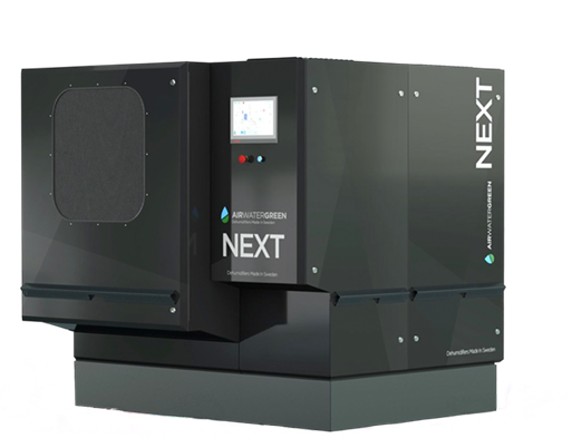
Earlier this year, Airwatergreen released the second generation of the NEXT dehumidifier, an updated version of the dehumidification platform, built on patented technology. This isn’t just the next iteration; it represents a new generation of thinking about dehumidification for the cold storage and frozen food industry.
Intelligence was built in from the start
Can a dehumidifier do more than simply react to a setpoint? Can it also help you understand how conditions inside a building change over time? From the earliest stages of development, Airwatergreen built sensors, connectivity, and data collection directly into the NEXT system.
“We’ve built in smartness from the start, so we have a full understanding of what’s happening in the machine, and also around the machine,” says Erik Bjernulf, CTO at Airwatergreen. “This means our service technicians can be at their own office and have a lot of reports up front, and the customers will have a lot of information about what’s going on in their process, so they can take action and optimize their operation.”
Indoor humidity rarely changes in a predictable way. People come and go, doors open, production cycles start, and outdoor conditions shift. Despite all that, dehumidification has traditionally been governed by a fairly blunt principle: if humidity crosses a threshold, the unit runs until it drops back below it.
With NEXT, Airwatergreen wanted to go further. Sensors and connectivity are built into the system to monitor and adapt the dehumidifier’s operation, while giving a clearer picture of how the indoor climate actually evolves over time.
Smart dehumidification runs on relevant data
Among other functions, NEXT modulates fan speed based on prevailing conditions. Measurement data is actively utilized to regulate the dehumidification process. Sensors can be positioned throughout the building, and the system can integrate with existing building automation systems. In the event of an unexpected humidity fluctuation, an alarm can be triggered to prompt investigation.
A high RH value does not tell the whole story. An anomaly may be temporary and caused by a specific activity. It might recur at the same time every day or deviate entirely from normal patterns. This type of data can be leveraged to better tailor dehumidification to the actual events occurring on-site.
One machine, several ways of working
Different situations call for different things from a dehumidifier. Sometimes humidity needs to come down fast; other times, activities like surface cleaning or washdown create short, sharp moisture spikes that need a different response.
NEXT now offers multiple operating modes:
- Auto Run — the default mode
- Target Mode — reaches a target relative humidity as quickly as possible
- Eco Mode — adapts operation to the actual moisture load to minimise energy use
- Wash Handler — built for environments with recurring, time-limited moisture peaks
For the user, this doesn’t mean more daily decisions, it means the unit responds to actual demand instead of constantly running for the worst-case scenario.
Energy is about timing, not just quantity
How much energy a machine consumes is one aspect. When it consumes that energy is another.
NEXT can utilize electricity prices based on 15-minute intervals. In Tariff Mode, this data is used to optimize regeneration cycles. When process parameters permit, a larger share of regeneration can take place when electricity prices are lower, and be reduced when prices peak.
Maintaining the correct climate will always be the primary priority. However, shifting operational cycles in time unlocks additional opportunities to optimize energy costs.
From remote monitoring to faster troubleshooting
This is also where Erik Bjernulf identifies one of the principal advantages of aggregating data over time. By comparing current readings with historical data, trends and deviations become much easier to detect. This could involve moisture peaks recurring at specific intervals, shifting indoor conditions, or an operational pattern that suddenly diverges from standard baselines.
Ultimately, this information contributes to a comprehensive understanding of both dehumidifier performance and the operational environment.
Technology that helps, not complicates
For most people running a dehumidifier day to day, the technology underneath it isn’t the point, maintaining a stable climate, catching fluctuations early, and avoiding wasted energy are what actually matter. That’s exactly why these capabilities were designed into NEXT from the start, with sensors, controls, connectivity, and the dehumidification process working together rather than bolted on afterwards.
Needs vary by facility and industry: some priorities a rock-steady climate, others are managing recurring moisture peaks, and others are chasing tighter control over energy costs. At its core, that’s what smart dehumidification means, using accurate data to run the machine according to the actual demands of the environment it’s in.
For more information, contact:
Filip Larsen
Business Development Manager
Mobile: (+45) 25 11 99 47
Email: Filip.larsen@airwatergreen.com
www.airwatergreen.com


 + 44 (0) 1400 283090


 September 16th, 2026.


























 + 44 (0) 1400 283090