Become a member

Getty Images vs Stability AI: The Copyright Battle Set to Shape the Future of AI

This last week has seen closing submissions being made in the case of Getty Images (US) Inc vs Stability AI Ltd. It would not be an exaggeration to say that this is probably the most significant copyright case in the last decade.

Background to the case

At its heart is whether, as Getty claim, the scraping of millions of images from its website, without consent, and using them to train Stability’s AI model “Stable Diffusion”, and then the subsequent outputs from Stable Diffusion, infringe the copyright Getty own in those images.

Now that the trial is over, a judgment would normally be expected in three months, so by October 2025. The judge, Joanna Smith J, is developing a high-profile in so called soft IP cases (broadly those that cover for example trade marks and copyright rather than the more “sciencey” patent cases), having previously had her judgment in the Lidl v Tesco litigation where she found Tesco’s yellow and blue Clubcard branding infringed Lidl’s trade marks and passed them off upheld by the Court of Appeal. An appeal in this Getty case seems inevitable given what is at stake.

The question of how copyright laws are going to be applied in the development of AI has achieved global profile in recent years. Significant litigation (in addition to the Getty case in the UK) is underway in several other jurisdictions, including the USA. High profile UK artists such as Elton John and Paul McCartney have spoken publicly about their alarm over AI “ripping off” artists. On the other hand, there is political pressure for the UK to be at the forefront of AI development not least in its search for economic growth, and there have been suggestions from some politicians of reform of the law to enable this to happen, such suggestions often not being particularly well informed about how copyright law actually works.

The subject Getty case is almost several trials in one – there are substantive disputes involving a number of key IP rights, namely infringement of trade marks, passing off, infringement of copyright, infringement of copyright’s cousin database rights, and associated “safe harbour” defences. This is a very high-level summary, as many of the issues, particularly round the copyright and database rights claim, are complex.

What are the claims?

This article focuses on the copyright and database right claims and their associated defences, as those issues are the most pertinent to the relationship of our copyright laws to AI.

There are really three different but related copyright claims being advanced by Getty;

  • Input
  • Output
  • Deployment

To establish the UK court’s jurisdiction, Getty needed to be able to show that there was downloading and storing of copyright works on hardware located in the UK as part of the process of training Stable Diffusion. Stability having done so in “the cloud” is unlikely to be enough. The problem for Getty here is that this is most likely to have taken place in the USA. But what if Stability had employees based in the UK doing this?

It would appear from the closing submissions that Getty may not have focussed on this aspect of their case by the end of trial and after the witnesses had been cross examined. We will have to wait for the judgement to find out, and obviously interested commentators such as myself are not privy to Getty’s thinking about its strategy and tactics in the case.

For claimants generally, although a case based on inputs is perhaps the most obvious way or first thought about how to advance a copyright AI case, the jurisdictional problems are likely to be significant where the AI models being trained are overseas, notably in the USA and China, and on cloud-based networks.

Output

This aspect of the case is all about whether the images then produced by Stable Diffusion infringe Getty’s copyright. Getty need to prove that a substantial part of their copyright works were reproduced in the output images created by Stable Diffusion (Stability argue that the images produced do not reflect “a substantial part of the intellectual creativity” of the photographer who took the original photograph). The actual legal test talks to “reproducing the work in any material form”, which has been interpreted by the courts as reproducing the whole or a substantial part”.

We will have to wait for the judgment to see if this subtle difference in language is intended to obscure what is actually an infringement, although it is understood from the closing submissions that this aspect of the case has also not been pressed by Getty.

Deployment

For most neutral observers, this is where it is probably felt that Getty have the best chance of success. The infringement case here is known as “secondary infringement”, which occurs where an infringer, (here, Stability), without licence of the copyright owner imports into the UK an article which is, and which he/she knows or has reason to believe is, an infringing copy of the copyright work.

The latter knowledge aspect of this test is likely to be easier to establish. It is the first aspect that still presents some serious challenges – does the word “article” cover something that is intangible such as an AI model? And can something be an “infringing copy” even if the article (assuming Stability is found to be an article) does not have any “copies” retained inside it?

Article

Stability’s argument is that the word “article” was never meant to mean anything other than a physical article one can touch hold and see. Getty on the other hand argues that legislation has always been read in light of subsequent technological developments. This sounds like a powerful argument – the law almost always lags behind technological developments – see for example how copyright law has adapted to the rise of the internet over the last two decades, with on line video platforms such as YouTube.

Infringing Copy

Getty say that infringing reproductions of copyright works were necessary to train Stable Diffusion, notwithstanding that such copies were transient in nature and not retained in the finished article. The relevant legislation (Copyright, Designs and Patents Act 1988) provides that copying can include the making of transient copies.

Legal defences to the claims

Stability rely on what are known as “E Commerce Safe Harbours”, which although deriving from an EU Directive take effect in the UK, even after Brexit. The particular defence likely to be most critical is the “hosting defence”. In outline, provided an intermediary operates within certain parameters outlined in the relevant legislation, it cannot be an infringer.

Stability says it is like Google – it merely processes data entered by third parties (i.e. users in Stability’s case, advertisers and users in Google’s case). Stability says it plays no active role in creating a new image and has no responsibility for its users’ actions. It is users they say who upload any infringing image. Thus, Stability seeks to shift responsibility onto its users, who one assumes might also be described as customers, saying it knows nothing of specific acts they may have committed.

Countering this defence, Getty says Stability is not an “intermediary” within the meaning of the hosting defence, as it is in a bi-partite not tri-partite relationship with its users, and in a bi-partite relationship one cannot be an intermediary. Further, Getty says, Stability goes well beyond a role which is merely technical, automatic and passive, which are characteristics required to fall within the safe harbour provided by the hosting defence.

Looking ahead to the judgment and its possible implications and consequences

Stability has said in its closing submissions at the end of the trial that if it loses, then UK users would not have access not only to Stable Diffusion, but also other internationally trained AI models – at least until the training of such models does not infringe a rights owners’ copyright works. Cue more hand waving from politicians agitating for a change in the law in search of economic growth.

But it would be equally true would it not that such an outcome would devalue the enormous value creative industries bring to the UK surely? According to a recent article in the Financial Times, the government has estimated that the UK’s creative industries generated £126bn in gross added value to the economy in 2022, roughly 5% of GDP, whilst employing around 2.4 million people. The FT question whether the “value add” of the AI industry will ever be of comparable scale.

Getty on the other hand says that a narrow interpretation of the relevant statute (i.e. a finding of non-infringement) would be problematic, and it is difficult not to see the force in that submission.

Some of those in favour of permitting scraping to further the advance of AI in the UK point to the “fair use” provisions in the Copyright, Designs and Patent Act 1988. Stability had originally relied on the “pastiche” fair dealing defence, arguing that the outputs generated are imitating the original work and are not a substitute nor does the imitation cause any harm to the original work, Generally, speaking the so called “fair use” provisions are for the purposes of “criticism review and reporting” before the introduction of the “caricature, parody, or pastiche” defence following the Hargreaves Review in 2012.

Whilst the trial presented an opportunity for judicial comment on the use and breadth of the pastiche defence, it is unsurprising that Stability chose to drop its pastiche defence during trial. The use of millions of images without payment for commercial enterprise does not fit easily within those provisions, as perhaps Stability and their lawyers recognised. As is always the case, it is for parliament to change the law, if a government feels change is needed, and for the courts to interpret the statutes in place at any one time.

It’s unlikely that this will be the last hearing in this case, and a trip to the Court of Appeal, and possibly even the Supreme Court, seems likely given the public interest

BFFF HEALTH & SAFETY GROUP MEET AT FARESHARE MERSEYSIDE

This week we met for our second British Frozen Food Federation Health & Safety Group meeting of 2025 at the FareShare UK Coronation Hub in Merseyside.
We all shared a humbling experience of how good food, which would ordinarily go to waste gets redistributed to those who really need it. The sites 90 volunteers and 13 vehicles work tirelessly to redistribute food but also provide innovative ways to prevent food waste such as turning potato fries into canned soups and providing nutritious food packs to those leaving hospital and going home to empty cupboards. These unsung heroes also upskill their volunteers providing opportunities for full time paid employment within the wider food industry. A massive thank you goes to our hosts Rachel McLean Colin Pryor Paul Karalius . We were also treated to a cooked lunch made from food which would have been wasted.

At this meeting we discussed the following topics:

Aggression & Violence in Retail,
Stress Management,
Primary Authority,
Occupational Health,
Materials Handling Equipment.

Our guest speakers from JTF Wireless Ltd Ashley Bannister Eve Coleman Morgan Lea Morris and provided an overview of the latest technology to reduce road risk and ensure food safety through temperature monitoring.

Thanks for those who attended today including Clare Flanagan Barry Robinson Paul Duncalf Michael Cox Millicent Holdsworth Hannah Russell Rachel McLean Paul Routledge Wendy Palmer Kathryn Tindall Rupert Ashby
To find out more about the gwork of the group, please contact simonbrentnall@bfff.co.uk

A BETTER FUTURE FOR FOODSERVICE: BIDFOOD HIGHLIGHTS THE IMPORTANCE OF BUILDING A MORE SUSTAINABLE, EFFICIENT AND RESILIENT INDUSTRY

In recent years, caterers across the UK hospitality foodservice industry have faced numerous challenges from rising costs and inflation, staff shortages, skill gaps, sustainability pressures, and a wave of new legislation.

Bidfood, one of the UK’s leading wholesalers, has unveiled a series of initiatives aimed at supporting a more sustainable, efficient and resilient industry to combat these issues, in an event focusing on carbon management, warehouse operational technology and pub sector support.

While research has shown that 27% of consumers think the government is responsible for ensuring food and drink eaten out of home is sustainable, 32% believe this responsibility lies with the venue, and 16% with suppliers[1], emphasising the need for collaboration across the supply chain to improve foodservice.

During Bidfood’s event, called ‘What’s Cooking at Bidfood?, the wholesaler revealed its plans to equip customers with the right tools and insights to make informed decisions around their carbon footprint, as well as the progress it’s made working with climate intelligence company, CarbonCloud.

The event also emphasised the need to address issues of food waste and water usage within foodservice, with Bidfood’s Development Chefs and Sustainability Team announcing the launch of a new food waste recipe book, ‘Waste not, saves lots’, with 15 recipes and expert guidance to help customers cut costs and utilise food waste.

The day also showcased steps the wholesaler has implemented to enhance the customer experience through technology. In partnership with software developers, CSD, Bidfood has created a host of bespoke software systems and a tracking tool to reduce stock waste, increase warehouse efficiency and fulfil more customer orders.

Bidfood has also improved its customer delivery notifications with ‘Smart Alerts’. Previously, customers could sign up for text or email alerts, informing them when a driver leaves a depot, with a link to a map to track them on their route. Now, customers will receive a notification when their delivery is next, and another when their order has arrived on site.

Finally, ‘What’s Cooking at Bidfood’ concluded with a focus on Bidfood’s suite of pub support. Having launched The Interactive Pub earlier this year, Bidfood spotlighted a series of innovative solutions for menus, upskilling staff and competitive socialising to empower pub operators and increase footfall.

Tim Adams, Sales and Marketing Director at Bidfood, said: “As the foodservice industry navigates mounting pressures from sustainability demands to operational challenges, we believe the future lies in smarter, more collaborative solutions.

“Through initiatives like our carbon labelling project with CarbonCloud, cutting-edge warehouse tech with CSD, and our brand-new food waste recipe book, we’re empowering our customers to drive meaningful change, reduce waste, cut costs and build further resilience. Together, we can shape a more efficient future for foodservice and be a positive force for change.”

PUBLICATION OF THE FOOD STANDARDS AGENCY’S MECHANICALLY SEPARATED MEAT (MSM) GUIDANCE

Members should be aware that the Food Standards Agency (FSA) has published new Mechanically Separated Meat (MSM) Guidance. This follows a 12-week public consultation on the Guidance, published on 28 February 2024.


The Guidance is intended to clarify how the definition of MSM should be interpreted and applied, and to support Food Business Operators (FBOs) to determine whether a product is MSM in line with the clarified definition. There may be products that were previously not classified as MSM that now must be correctly classified as MSM. FBOs that intend to produce MSM must have approval to do so and it is the FBO’s responsibility to obtain it by applying to their competent authority.


The Guidance applies to relevant establishments in England, Wales and Northern Ireland. The Guidance may also be used by local authorities, FSA Operational teams and Department of Agriculture, Environment and Rural Affairs (DAERA) staff in Northern Ireland to support official controls and ensure consistency of the regulatory approach.


Businesses not compliant with the clarified definition of MSM will be expected to work towards compliance for MSM production. Enforcement of the legislative requirements will be carried out using a risk-based and proportionate approach. After publication of the Guidance, FBOs will be expected to evidence a clear pathway to achieving compliance when their establishments are inspected. The evidence must demonstrate that compliance will be achieved in the shortest, reasonable timeframe, for this to be considered as part of the proportionate enforcement approach.


The FSA, as the regulator, must uphold the law but recognises that it may take time for some FBOs to make the necessary changes. It is a priority that food is what it says it is and providing consumers with accurate and informative food information about the food they are buying is one of the fundamental principles of food labelling law. It is the responsibility of food businesses to comply with the applicable rules and some business operators may need to undertake labelling changes to comply with the clarified rules.


Where labelling non-compliance is identified, enforcement authorities are expected to assess these on a case-by-case basis, taking a risk-based, reasonable, and proportionate approach to enforcement, having regard to the Food Law Code of Practice, and their enforcement policies. Enforcement authorities will need to consider the law and relevant published guidance when considering an appropriate approach.


If you have enquiries, please contact MSM@food.gov.uk as the first point of contact.

INTRODUCING COSTA BRAVA MEDITERRANEAN FOODS

Let us introduce ourselves: Costa Brava Mediterranean Foods, one of the newest members of the BFFF.

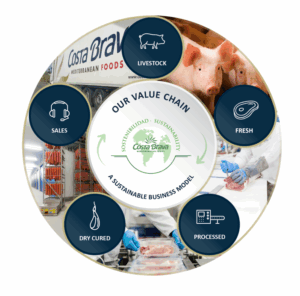
Founded in 1965 in the Costa Brava Region (Catalonia, Spain), we are part of the Cañigueral Group, one of Europe’s leading meat industry groups. We operate 17 specialised plants forming a robust industrial structure: 3 plants dedicated to fresh and frozen meat, 3 specialising in processed products, and 11 focused on the production of cured sausages and Jamón Serrano.


The Group also has its own livestock division, which allows us to maintain a fully integrated pork supply chain. This model enables us to exercise complete control over the entire value chain — from raw material, certified for animal welfare, to the end customer.


Our activity is divided into three main divisions, designed to meet all market needs:

  1. Fresh pork and beef: we stand out as specialists in white pork and in 50% Duroc pork (a breed renowned for its superior quality and high fat marbling, which results in more tender and flavourful meat), and Halal beef (with cuts tailored to each customer’s preferences). We offer versatile formats and ready-to-cook solutions that support efficient and profitable kitchens.
  2. Processed products: a growing, gluten-free range that is practical, and full of flavour. We are the leading producer and distributor in Spain of fresh processed pork and beef products, with an annual volume of 56,000 tonnes. The range includes croquettes, marinated meats, cutlets and other items, along with a specific line of plant-based products.
  3. Cured sausages and Jamón Serrano: we are market leaders in Spain— top 1 producer of fuets and top 3 producer of Jamón Serrano. We offer a wide range of formats: sliced, snacks, whole and half pieces, trays, skin packs, gift boxes… Our craftsmanship and attention to detail result in high-quality products with an authentic Mediterranean flavour.

We have dedicated professionals for each sales channel, with the experience and know-how to deliver tailored solutions for every client.

For the retail sector, we offer a range designed specifically for the British consumer, with practical and attractive formats, sustainable and distinctive packaging, and extensive custom product development capacity, both for private label and branded lines. All our products meet the highest quality and food safety standards, holding international certifications such as IFS and BRC.


In the Foodservice channel, we offer solutions designed for professionals: frozen products using the IQF method, and recipes that guarantee speed, flavour, and performance in the kitchen. We offer Halal, gluten-free, and plant-based options, with a range that responds to current market demands and ensures efficient, reliable operations.


With a well-established presence in the UK, we position ourselves as a trusted partner for both retailers and Foodservice professionals, delivering safe, profitable solutions with a Mediterranean identity.


Find out more about us at: www.costabravafoods.com/en or contact us directly at sales@costabravafoods.com

THE PRODUCTION EXCELLENCE JOURNEY: WHY LEADING FOOD MANUFACTURERS CHOOSE QAD TO POWER END-TO-END OPERATIONAL AGILITY

Competing on Margin and Agility: Why Manufacturers Must Rethink Their Systems

The food industry is fiercely competitive. Demand volatility, frequent promotional shifts, ingredient sourcing constraints, and tight production windows define the playing field. Yet many manufacturers still rely on disconnected tools and legacy ERP systems to manage what has become a fast-moving, data-driven, multi-site operation.

Outdated platforms create real-world risk. Fragmented data across finance, supply chain, and production slows decision-making and creates blind spots across the value chain. Growth via acquisition becomes a strain instead of a strategy. Planning becomes reactive. Labor becomes isolated. Capacity gets wasted.

QAD offers a different path.

Most ERP systems function as systems of record. They track what’s happened.  They don’t help you respond to what’s happening now or predict and prevent future problems from occurring. QAD is different. It’s a system of action.  Purpose-built for today’s food manufacturers who face constant disruption, shifting demand, and supply chain volatility.

Built specifically for complex manufacturing environments, QAD Cloud ERP gives food manufacturers a scalable, resilient digital foundation. When paired with QAD’s Manufacturing Optimization Platform (which includes production planning, advanced scheduling, and connected workforce capabilities), manufacturers begin a Production Excellence Journey that prepares them not just to compete, but to lead.

ERP Built for Manufacturing at Scale

QAD’s Cloud ERP is more than a system of record. It is a system of agility, built to enable visibility, control, and speed across the enterprise. From financial consolidation to global supply chain orchestration, QAD ERP supports manufacturers in unifying core business processes and positioning for right-sizing.

Support for M&A and Global Expansion
In a category where growth often means acquiring new brands, facilities, or co-manufacturing partners, QAD ERP enables rapid post-acquisition integration. Finance teams gain full visibility across multiple entities and currencies, while operations standardize procurement, inventory, and compliance under one global platform.

Unified Financial Management
QAD ERP simplifies multi-site and multi-national operations by consolidating financials into a single system. Leadership can act on real-time data, monitor profitability across products and regions, and streamline regulatory compliance. This clarity enables more confident strategic decisions and greater operational control.

Supply Chain Synchronization
QAD delivers full supply chain visibility, from raw material procurement to final delivery. Built-in analytics and automation ensure purchasing, production, and distribution operate from the same plan, reducing waste and increasing service levels.

With QAD ERP as the core, manufacturers gain the stability and scalability required to pursue continuous improvement, respond to change faster, and prepare the business for long-term transformation.

The Manufacturing Optimization Platform: Turning Plans into Production

ERP is only part of the journey. Operational excellence happens when planning intelligence, production execution, and frontline performance work together in real time. That’s where QAD’s Manufacturing Optimization Platform comes in.

Forecasts and Demand Planning
Sales demand means little if it can’t be translated into an actionable forecast. QAD helps companies capture demand signals from multiple sources—sales orders, customer forecasts, historical data, and market trends. For make-to-order environments, QAD allows actual customer orders to drive production demand directly, while still considering forecasted volumes for long-lead materials and resource allocation. The result: smarter inventory, fewer surprises, and more confident decision-making.

Production Planning
A forecast is only the starting point. Turning that forecast into a solid production plan is where the real work begins. QAD connects demand with real-world constraints—like capacity, labor, materials, and supplier schedules. This ensures that plans are not just theoretical, but truly executable.

You need production planning and scheduling because you can’t schedule your way out of a bad plan. Without clear planning, even the best schedules fail. QAD enables planners to align service levels, costs, and profitability—before production ever begins.

Advanced Scheduling
Manufacturers operating in fast-paced, multi-SKU environments face constant changeover challenges and variable throughput. QAD Advanced Scheduling creates optimized production sequences based on constraints, labor, and asset availability. This results in fewer bottlenecks, reduced downtime, and greater responsiveness to last-minute changes.

Redzone: Boosts Frontline Productivity and Engagement

Operators, supervisors, and frontline teams are critical to execution. QAD’s connected workforce capabilities digitize task management, performance tracking, and communication. Real-time visibility empowers teams to reduce unplanned downtime, act on performance data, and contribute directly to plant-level improvement.

Together, these tools form the Manufacturing Optimization Platform; a suite designed to close the loop between enterprise planning and plant floor execution.

The Production Excellence Journey: Transforming from the Inside Out

True transformation doesn’t happen with technology alone. It happens when strategy, execution, and systems align. The Production Excellence Journey is QAD’s vision for helping manufacturers take control of complexity and turn it into a competitive advantage.

By combining the operational backbone of QAD ERP with the agility of the Manufacturing Optimization Platform, organizations begin a structured evolution toward:

  • Higher throughput with fewer resources – Minimized downtime, increased OEE and output by labor hour
  • Reduced inventory and working capital – Improved inventory turns, lowered DIO and decreased downtime
  • Greater schedule adherence – Higher on-time rates and better alignment of planned vs. actual production
  • Faster integration of acquisitions – Shortened system integration timelines and quicker financial close
  • Increased visibility and accountability – Real-time data access, faster exceptions, audit trails, and higher digital adoption

Don’t Let Legacy Systems Set Your Limits

Shelf-stable food manufacturing is only getting more complex. Competitors are digitizing fast. Retailers expect tighter delivery windows and greater responsiveness. Talent is harder to retain. Costs remain volatile. In this environment, operating on disconnected, outdated systems is not just inefficient, it is a strategic liability.

QAD provides a way forward: a modern, purpose-built cloud ERP platform backed by real manufacturing execution tools. With QAD, manufacturers are not forced to choose between control at the top and agility at the plant. They are both; unified, scalable, and ready for growth.

Ready to Modernize? Then Take the First Step

The future belongs to manufacturers who invest in the systems that support speed, precision, and accountability across every layer of the business. Don’t let outdated systems hold you back. Visit www.qad.com to schedule a conversation or reach out to me directly at stephen.dombroski@qad.com. Let’s talk about how QAD can help you streamline operations, boost agility, and set your business up for long-term success.

Member Benefits

Exclusive Partnership deals on key products and services:

  • BFFF energy deals and rates
  • Vypr member deals and introduction
  • Defib Plus deals
  • Company Shop – membership
  • Mentor – MHE training health check

Exclusive access to networking opportunities and events:

  • Meet the Buyer events (retail & foodservice)
  • Annual Business Conference with networking dinner
  • Specialist H&S and Technical Conferences
  • Special interest groups (packaging, frozen food temperatures)
  • Annual Lunch
  • Awards Night
Upcoming Events More Events
Sponsorship Packages

We offer a range of sponsorship opportunities to BFFF members across our events throughout the year, with flexible packages that can be tailored to suit your business objectives.

Contact Us
British Frozen Food Federation Members Logo
what our members say...
  • Wakefield Council

    “What an amazing piece of work and indicative of how BFFF respond to the concerns of their members and make an impact on the whole industry sector.”

    See Full Quote

  • Sysco

    “You guys really ‘Do The Right Thing’ for the good of the industry”

    See Full Quote

  • Darta

    “The BFFF awards night is becoming an “appointment not to miss” on our calendar and we again enjoyed it immensely together with lots of well-known people from our industry. The…

    See Full Quote

  • Kantar Worldpanel

    “The Business Conference was an excellent day that was very well organised and allowed so many likeminded individuals in the room to learn so much more around the Frozen industry….

    See Full Quote

  • Lakeside Food Group Ltd

    “This Not For EU labelling situation alarmed us and quickly became a major worry to our business. These are times when you really rely on some support and from previous…

    See Full Quote

  • Meadow Vale Foods Limited

    “We had a few questions with respect to the new EPR waste packaging legislative changes. I know some of my colleagues have been assisted by BFFF in the past so…

    See Full Quote

  • Newberry International Produce Ltd

    “I am writing to express my heartfelt gratitude for the outstanding event you organised. I have only worked in this sector for the past nineteen months coming from twenty-five years…

    See Full Quote

  • Place UK Ltd

    “The BFFF 2024 Conference was compelling and thought provoking, with a many relevant and interesting topics covered at great pace and some depth by excellent speakers – will certainly attend…

    See Full Quote

  • Roswel Spedition GMBH

    “Thank you and the team for rushing around so brilliantly before, during and after the conference. It was pleasure to be part of the conference.”

    See Full Quote

  • Seara

    “The event was great, in my opinion. Not only it was very well organised, but the venue and the catering were excellent too. Furthermore, the content of the presentations was…

    See Full Quote

Website Designed & Built by we are CODA