Become a member

GRACE CARES EXPANDS CAPACITY DOUBLING IMPACT THANKS TO BUSINESS SUPPORT

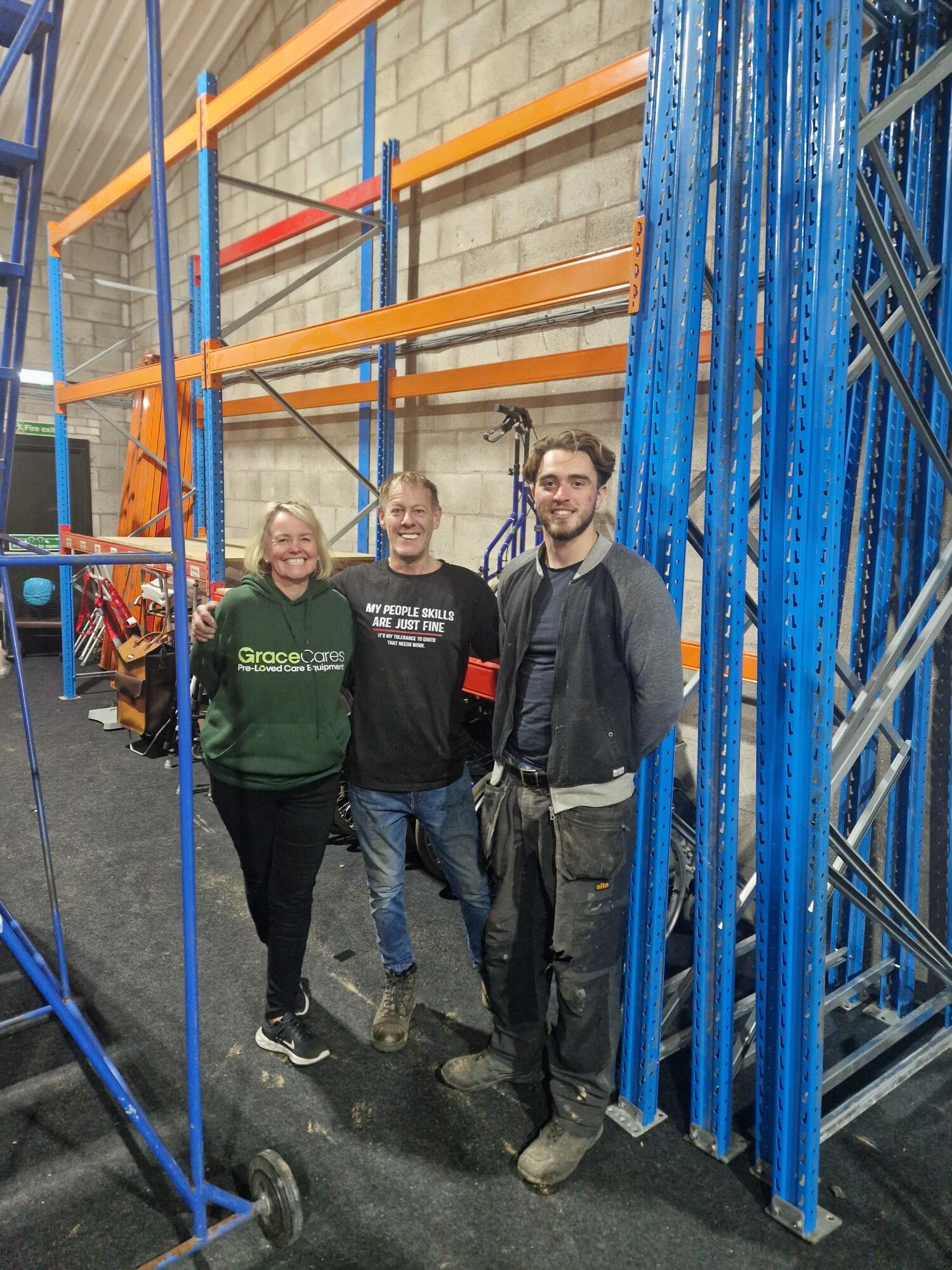
Grace Cares CIC, thanks to the generous support of Oakland International and Rack Collapse Prevention, are reaping the benefits of a brand-new warehouse racking system.


Emma Smith, Co-Founder of Grace Cares commented: “This new racking system might not sound glamorous, but it’s a total game-changer for us. It means we can process and store more equipment, respond faster to those in need, and ultimately do more good.


“We’re so grateful to these brilliant businesses who’ve made this possible, it’s a fantastic example of community collaboration for social and environmental impact. It is such a joy to see the difference it has made to the working areas for our wonderful volunteers, they love the new space.”


Installed at their Grace Cares Hub at Elmhurst Business Park, the Lichfield-based not-for-profit is on a mission to make care more sustainable by taking a major step forward in its mission to rescue greater numbers of care equipment from landfill and support even more people in need.

 

The new racking system will significantly increase the hub’s storage capacity, allowing Grace Cares to sort, store and redistribute more equipment safely and efficiently. It’s a vital part of the charity’s bold goal to double the amount of care equipment saved from landfill and double the number of people they currently support across the UK.


The installation was made possible through donations and support from businesses that share Grace Cares’ commitment to sustainability and social responsibility.


Oakland International Co-Founder Dean Attwell added: “Grace Cares is a perfect example of a purpose-led organisation doing vital work for the planet and people at grassroots level. We believe in backing initiatives that create long-term positive impact, and it’s been brilliant to use our logistical and warehousing knowledge to support Grace Care’s next stage of growth.”


Grace Cares has already redistributed over 2,000 pieces of care equipment, supported over 1,500 people, and delivered vital wellbeing activities and hardship grants across the country. With the added capacity from the new racking system, the team is now in a stronger position to build on that momentum.


Rack Collapse Prevention Managing Director Craig Attwell commented: “We’re proud to support Grace Cares in such a meaningful way. Their work makes a real difference to people’s lives while tackling the huge issue of waste in the care sector.


“Helping them expand their operations is something we’re honoured to be part of.”


Grace Cares continues to welcome support from individuals and businesses who want to help build a more sustainable, compassionate future for care, locally, nationally, and beyond.


<Ends>

Image details from L to R:  Co-Founder Grace Cares Emma Smith, Rack Collapse Prevention Managing Director Craig Attwell, and Rack Collapse Prevention’s Tommy Taroni.


Grace Cares Volunteer Stefan Szulc.


Editor’s notes:


About Grace Cares: Grace Cares is a not-for-profit social enterprise committed to making care more sustainable. By rescuing and redistributing surplus care equipment, supporting older people, and championing environmental action, Grace Cares is creating a circular economy within the care sector and improving lives across the UK.


About Oakland International: A Certified B Corporation, Established in 1998, Oakland International is an award-winning total supply chain solutions family business with a reputation for innovation through sustainability, servicing retail, wholesale, discount and convenience markets via their UK and Ireland multi-temperature-based facilities.


About Rack Collapse Prevention: A trusted UK and EU patented top supporting racking safety system which prevents catastrophic failure: in a collision event pallet racking remains standing, protecting both staff and inventory.


For all enquiries please contact: Kathryn Watts 07970 547469 e: k.watts@evopr.com – If you do not wish to continue to receive press releases in the future, please let me know and I will remove your address from my distribution group.


SYSCO GB ANNOUNCES SPONSORSHIP OF ASHFORD PRIDE

Sysco GB has announced that it will be the main sponsor of Ashford Pride this year as part of its Pride Month celebrations.

Ashford Pride takes place on 21 June and the sponsorship is part of a packed programme to showcase Pride at Sysco GB, with every site in the network undertaking activity to support the LGBTQ+ community.

The activities are part of a long-term drive by Spectrum, Sysco GB’s Colleague Resource Group for the LGBTQ+ community, to help create a better understanding of the issues and needs of the LGBTQ+ community.

The Pride programme includes Famous Faces, highlighting some of the famous faces who are part of the LGBTQ+ community, Fun with Flags, showing what the flags associated with the Pride movement represent, and Pride Gay Anthems, featuring some of the songs that the LGBTQ+ community has embraced.

The Spectrum Colleague Resource Group has committed to grow the existing Spectrum Champion’s network across Sysco GB throughout the remainder of 2025 into 2026.

All Sysco’s businesses around the world will come together on June 25 to celebrate Sysco’s Global Pride Day, as the company embraces the importance of diversity across the world.

Paul Nieduszynski, Chief Executive of Sysco GB, said: “I’m proud of the way that the business, not just in the UK, but globally, has come together to support the LGBTQ+ community. At Sysco, it’s not just about a day or a month, it’s about supporting colleagues for life. 

“Creating and embracing a diverse workforce is incredibly important to our business and Spectrum, the HR team and the Senior Leadership all play their part in making a lasting contribution to how diversity is viewed within Sysco GB.”

Jon Newman-Schultz and Aby Rishworth Co-Chairs of the Spectrum group at Sysco GB, said: “It’s wonderful to see how Pride month has grown across Sysco GB, and the fantastic job it does in raising awareness of the support that is on offer across the group. Our Pride programme will ensure that colleagues can access the support and information they need to feel comfortable brining their whole selves to work.”

As part of its programme, Sysco GB will be fundraising for AKT, which supports displaced LGBTQ+ young people, providing safe homes and a better future.

Ends


For further information please contact Kevin Coles – kevin@fifthdimensionpr.com or 07776026012

L&G EXPANDS PRIVATE CREDIT PORTFOLIO WITH £250M MAGNAVALE COLD STORAGE INVESTMENT

L&G expands private credit portfolio with £250m Magnavale Cold Storage investment UK & European Real Estate Debt team completes loan to diversify into new logistics sectors

London, 12 June 2025 – L&G announces the successful completion of £250 million private debt investment with Magnavale Ltd. (‘Magnavale’ or ‘the Company’) over a 10-year period. The debt facility totals £500 million, co-arranged by L&G and a US institutional investor. L&G invested on behalf of a number of internal and external client mandates, in a transaction which marks an expansion of the firm’s real estate debt portfolio into new logistics sectors.

Magnavale is a leading UK-based provider of temperature-controlled storage and value-added services for the food industry operating from four strategically located cold storage facilities, providing a critical storage solution to ensure supply of food can cope with seasonal demand and unpredictable supply shocks.

With structural trends such as unpredictable climate cycles, population growth and geopolitical instability, cold chain storage can minimise the disruption to supply chains and greatly contribute to food security in the UK economy. Robust end-to-end cold chains are also integral to support the reduction of food waste.

James Spencer-Jones, Head of Real Estate Debt, UK & Europe: “I’m delighted to announce we’re expanding into cold storage within our real estate debt portfolio, in particular with a market-leading provider such as Magnavale. This investment provides an opportunity to support critical infrastructure within our supply-chains, to reduce food waste and potential supply shortages”.

Andrew Lawrence, Director, Sadel and Magnavale: “We are proud to partner with L&G and our US institutional co-investor to support Magnavale’s continued growth. Their backing is a strong endorsement of both our strategy and the critical role that cold chain infrastructure plays in securing the future of the UK’s food supply chain. This investment reinforces Sadel’s approach of building best-in-class operations and prioritising efficiency through targeted, long-term investment. This partnership enables us to accelerate our expansion, enhance resilience across our national network, and deliver energy-efficient, future-ready facilities that meet the evolving needs of our customers and the wider economy”.

Patrick Sweeney, Investment Manager, Real Estate Debt UK & Europe: “We have high conviction for the U.K cold storage sector which demonstrates unique and compelling investment fundamentals. Magnavale has invested a significant amount in future proofing their portfolio and we are delighted to be supporting them in their next phase of growth”.

The Lender Group was advised by Clifford Chance and CBRE. Macfarlanes advised the Company. Magnavale’s comprehensive suite of services includes blast freezing, up-tempering, contract packing, datecoding, labelling, and export services. These offerings are designed to streamline the cold chain, reduce costs, and minimize complexity for food manufacturers, retailers, and suppliers.

In February 2025, Magnavale opened the UK’s largest single cold store, boasting 101,000 fully automated pallet spaces at it’s Easton site. In addition to this, the company has recently upgraded its other facilities across Chesterfield, Scunthorpe, Warrington with best-in-class plant and equipment, and completed redevelopment and extension works, providing significantly improved energy efficiency and extending its network capacity. Across all sites, Magnavale offers a combined capacity exceeding 350,000 pallet positions. Magnavale Ltd is owned by Sadel Group, a Luxembourg-based family office. Private Markets platform is a major growth driver for Legal & General, holding £57bn AUM across real estate, infrastructure, private credit, and venture capital, and backed by a team of 200+ investment professionals.


Notes to Editor


PLEASE NOTE.


THIS PRESS RELEASE ORIGINATED FROM L&G AND HAS BEEN FORDWARDED TO YOU BY SADEL/MAGNAVALE.


THE ORIGINAL PRESS RELEASE CAN BE FOUND ON L&G’S WEBSITE: https://group.legalandgeneral.com/en/newsroom/press-releases/l-g-expands-private-credit-portfolio-with-250m-magnavale-cold-storage-investment


About L&G

Established in 1836, L&G is one of the UK’s leading financial services groups and a major global investor, with £1.1 trillion in total assets under management (as at FY24) of which c. 44% (c. £0.5 trillion) is international.

We have a highly synergistic business model, which continues to drive strong returns. We are a leading player in Institutional Retirement, in Retail Savings and Protection, and in Asset Management through both public and private markets. Across the Group, we are committed to responsible investing and dedicated to serving the long- term savings and investment needs of customers and society.


About our Asset Management business

L&G’s Asset Management business is a major global investor across public and private markets, with £1.118 trillion in AUM.* Our clients include individual savers, pension scheme members and global institutions.

We provide investment solutions from index-tracking and active funds to liquidity and liability-based risk management strategies.

Our investment philosophy and processes are focused on creating value over the long term. We believe that incorporating financially material sustainability criteria, when relevant to our clients, can create value and drive positive change. This reflects L&G’s purpose: ‘Investing for the long term. Our futures depend on it.’

*Source: L&G internal data as at 31 December 2024. The AUM disclosed aggregates the assets managed by L&G in the UK, US, and Hong Kong (2018-2019 only) and Singapore from July 2023. Excludes assets managed by associates (Pemberton, NTR, BTR).


Further information

Name: Bella Golding

Role: Senior Communications Executive

Business: Asset Management

Tel: +44 (0)7596 914332

Email: Assetmgtpress@lgim.com

Data Protection and the Adoption of the EU TDM Exemption

In this blog we explore if, and to what extent, the data protection legal framework in the UK can prevent AI training models from using third party intellectual property (IP), and more particularly, material protected by copyright and related rights. This becomes even more meaningful in light of the government’s consultation on whether to adopt a similar approach to the text and data mining (TDM) exemption as is currently in force in the EU.

We will look briefly at the EU TDM exemption, the current TDM exception under the Copyright, Designs and Patents Act 1988 (CDPA) and the government’s consultation on whether to adopt the EU TDM exemption. We will then look at the implications for AI developers of using publicly available material protected by IP rights that may contain personal data in training their models and the steps needed to overcome such implications. Finally, we will conclude that, to the extent that material protected by IP rights does include personal data, this could significantly impair the ability of AI model developers to use such material in training their models.

The EU TDM exemption

According to Article 2(2) of the EU Directive on copyright in the Digital Single Market (the DSM Directive)[1], TDM means:

“Automated analytical technique aimed at analysing text and data in digital form in order to generate information which includes but is not limited to patterns, trends and correlations”.

A majority of generative AI models are trained with content that is publicly available. This is done using software which extracts information available online. The DSM Directive allows such extraction of content without permission from owners of the copyright in such content on two occasions:

  • under Article 3(1) for reproductions and extractions made by research organisations and cultural heritage institutions in order to carry out, for the purposes of scientific research, text and data mining of works or other subject matter to which they have lawful access, and
  • under Articles 4(1) and 4(3), for reproductions and extractions of lawfully accessible works and other subject matter for the purposes of text and data mining […] on condition that the use of works and other subject matter referred to in that paragraph has not been expressly reserved by their right holders in an appropriate manner, such as machine-readable means in the case of content made publicly available online.

The CDPA exception

TDM is not totally prohibited in the UK. Although the CDPA does not make specific reference to a TDM exception, Section 29A clearly allows such operations for scientific non-commercial research. Section 29A of the CDPA provides that:

“The making of a copy of a work by a person who has lawful access to the work does not infringe copyright in the work provided that the copy is made to carry out a computational analysis of anything recorded in the work for the sole purpose of research for a non-commercial purpose […]”.

The UK government’s consultation on copyright and AI

The government maintains that the current uncertainty in the UK around use of works protected by copyright and related rights in training AI models prevents both growth of the AI sector and rights holders from being remunerated for their works used in AI training. The government’s Copyright and AI consultation (which closed in February 2025) aims at stopping this uncertainty to unlock growth. One of the interventions the government proposes to achieve this aim is the adoption of the “text and data mining” exemption to copyright law, similar to the EU TDM exemption.

The government maintains that:

“This approach seeks expressly to balance the objectives of access to works by AI developers with control over works by right holders supported by increased trust and transparency for all parties.”

In practice, it means that AI developers can train their models using publicly available works that are available to them without permission from right holders, if any, unless the latter have expressly opted out from use of their work in this way.

Personal data and training AI models

Although the most obvious source for training AI models is publicly available material online, this is not the only source of such material. AI developers may access non-publicly available material for training their models through licensing arrangements. In both instances the material may contain personal data protected by data protection laws. When the material contains personal data, applicable data protection laws must be observed. For the purposes of this blog, it is personal data available online that we are primarily concerned with, given the nature of TDM as the main tool for searching information and data on websites.

Personal data publicly available

The Information Commissioner’s Office (ICO) makes it clear that the fact that personal data is publicly available doesn’t mean that the data can be freely used.

“If you obtain personal data from publicly accessible sources (such as social media, the open electoral register and Companies House), you still need to provide individuals with privacy information, unless you are relying on an exception or an exemption.”

However, even if AI developers rely on the exception that providing a privacy notice would be impossible, they “must carry out a DPIA in order to identify and mitigate the risks associated with” further use of personal data. (see What common issues might come up in practice? | ICO).

In other words, if AI developers use material that is publicly available, and which contains personal data, they must ensure that they have a lawful basis for using the data and they must also serve a privacy notice to data subjects. Even if they can be excused from serving a privacy notice, they will still need to run a data protection impact assessment (DPIA) where processing poses a high risk to data subjects’ rights and freedoms.

Of note, the ICO emphasises that “where the use is less likely to be expected, or could significantly affect individuals” privacy notices must be provided as soon as possible after the data is obtained (which would mean much sooner than the one month long stop date for doing so).

The need to carry out a DPIA is certainly an additional burden that developers of AI will need to overcome. The ways any outputs of the AI model may be used by its users, and whether the outputs themselves will contain personal data, must certainly be taken into account when running a DPIA as such uses may pose a higher risk to data subjects.

AI Developers as controllers of personal data

In addition to the above, AI developers as controllers of personal data will have to comply with a number of additional obligations under data protection laws such as to:

  • comply with the principles listed in Article 5 of the UK GDPR, i.e. to ensure that personal data are processed lawfully, fairly and in a transparent manner, collected for specific, explicit and legitimate purposes, be adequate, relevant and limited to what is necessary for the processing purposes, be accurate and up to date, kept for no longer than is necessary for the purposes of processing the data and processed securely;
  • inform the data subjects of their right to request rectification or erasure of their data or to restrict the processing, the right to lodge a complaint and the existence of any automatic processing of their data; and
  • facilitate the exercise of the data subject’s rights.

Therefore, there are numerous practicalities that AI developers should consider before embarking on the use of publicly available material protected by intellectual property rights that may contain personal data. These practicalities involve a considerable administrative and potential financial burden that surely the AI industry would need to consider, especially taking into account the commercial uses the EU TDM exemption will allow. Although it is true that the ICO has issued only a limited number of fines, its policy on the issue could change considerably if AI developers make huge amounts out of the use of personal data for training their AI models for commercial purposes.

Of some relevance, in August 2023, the ICO alongside eleven other data protection and privacy authorities published a joint statement calling for the protection of people’s personal data from unlawful data scraping taking place on social media sites. Although the statement was focused on social media on the back of a number of mass data scraping incidents, the statement makes clear that such incidents may be reportable to the ICO. In the Copyright and AI consultation it is stated that the ICO is currently reviewing the intersection of generative AI and data protection with a view to issuing relevant guidance in due course and this is still today forthcoming.

So, can data protection help protection of IP in AI?

Undoubtedly, AI developers wishing to use material protected by copyright and related rights that contains personal data would need to comply with data protection legislation on top of the protections provided under copyright laws. This is the case already in the UK given that TDM is to some limited extent permitted under the CDPA for non-commercial research purposes; but it will be of greater importance if the government decides to proceed with adopting the EU TDM exemption allowing use of such content to train AI models for commercial purposes.

Since commercial uses may pose a higher risk to data subjects, data protection legislation can indeed contribute to some extent in protecting works protected from IP from being used in training AI models. The requirement to run a DPIA alone could be a deterrent to AI developers from using copyright content that involves personal data.

The exercise of data subject rights can also add a disproportionate administrative burden to AI developers. Finally, the ICO’s stance over its fine imposing powers may change if personal data are to be used for highly profitable purposes.

[1] Directive (EU) 2019/790 of the European Parliament and of the Council of 17 April 2019 on copyright and related rights in the Digital Single Market and amending Directives 96/9/EC and 2001/29/EC.

Why Contractual Terms and Conditions are Critical in the Credit Process

In today’s competitive business landscape, safeguarding your company’s financial health is more crucial than ever. One often-overlooked tool in this pursuit? Clear, enforceable contractual terms and conditions. In this blog, we walk through key insights from our recent webinar focused on how strong contractual frameworks support better credit management, reduce disputes, and protect your bottom line.

Protecting payment and relationships

Whether you’re selling products and services or buying them, it’s essential to have robust contracts that clearly outline responsibilities and expectations. Without well-structured agreements, businesses risk non-payment, disputes, or supply chain vulnerabilities. Contracts should foster trust with suppliers and customers alike, ensuring prompt payments and fair dealings.

The core contractual elements to get right:

1. Payment terms
Clearly defined payment terms are essential for maintaining financial control. Specify when and how payments should be made and consider using automated reminders to support cash flow. To encourage timely settlement, include provisions for interest or penalties on late payments.

2. Default and dispute handling
Set out clear procedures for dealing with late payments and resolving disputes. This should include escalation pathways—such as involving senior personnel—and consider incorporating formal mechanisms like mediation to resolve issues efficiently and maintain commercial relationships.

3. Retention of title
Retention of title clauses allow sellers to retain legal ownership of goods until full payment has been received. These provisions are particularly valuable in insolvency situations, providing an added layer of protection for suppliers.

Business-to-business contracts vs. business-to-consumer

Understanding your customer, business or consumer, is fundamental. Consumer contracts are subject to tighter legislative requirements under the Consumer Credit Act 1974 and Consumer Rights Act 2015. Misclassification or non-compliance can have serious legal consequences.

Express and implied terms

Not all terms need to be spelled out to be enforceable, some are implied by law or custom. However, providing clarity reduces ambiguity, record all communications and negotiations and distinguish between legally binding terms and marketing-style “representations.” A poorly defined clause could be deemed unfair or even void in court.

Incorporation of terms

Your terms and conditions are only effective if they are properly incorporated. It’s important to make sure they are presented before the contract is formed (e.g., pre-sale, on sign-up screens), any unusual or onerous clauses are clearly highlighted (consider the “red hand” principle from case law) and users accept them via click-throughs or signatures where applicable.

Online contracts and website terms

In the age of e-commerce, your website’s T&Cs are your frontline legal defence. Lessons from cases like Betfred v Green highlight that:

  • Simply linking to T&Cs is not enough.
  • Users must be clearly shown key clauses.
  • Terms must be fair and understandable—especially when dealing with consumers.
  • Avoid the “battle of the forms”

Where both parties exchange contracts or purchase orders with their own terms, disputes arise over which terms govern the deal. To avoid this, state clearly that your terms apply exclusively and ensure all departments use the same version of your standard terms.

Periodic review: A contract is not “set and forget”

Regularly reviewing your contractual documents helps you to align with changing legislation and business practices, avoid reputational risks from outdated or unfair terms and satisfy insurers or regulators who may request your review history.

Key clauses that deserve attention

When drafting or reviewing contracts, pay special attention to:

  • Interest rates and payment schedules (especially in long-term agreements where inflation may impact pricing).
  • Termination rights: Define clear processes for ending agreements and the consequences.
  • Dispute resolution mechanisms: Mediation vs. litigation, make the intention clear.
  • Waivers: Don’t accidentally give up your rights by failing to act or by showing leniency without reservation.
  • Jurisdiction clauses: Specify which country’s laws apply.

Retention of title (ROT)

ROT clauses can make the difference between recovering goods or losing them in insolvency. Properly drafted clauses can give you priority over other creditors, help reclaim goods still on a customer’s premises and cover not only specific goods but potentially proceeds from their resale.

Why payment terms are crucial to credit control

Payment terms are a crucial element of effective credit control, providing a structured framework that underpins financial stability and operational efficiency. Clearly defined payment clauses help manage cash flow by clarifying when funds are due, enabling better planning and budgeting. They also serve as a risk mitigation tool, reducing the likelihood of late or missed payments that can disrupt business operations.

Transparent payment expectations foster stronger customer relationships, building trust and accountability on both sides. Ultimately, well-crafted payment terms lay the foundation for sustainable growth by ensuring financial certainty and predictability.

Termination

It is essential to ensure that termination rights within a contract are clearly defined, legally compliant, and fairly balanced. Clearly stating when and how each party can exit the agreement provides certainty and reduces the risk of disputes. These provisions must also comply with relevant legal and statutory requirements to remain enforceable. Moreover, termination clauses should be balanced, avoiding overly one-sided terms that could be deemed unfair and ultimately unenforceable by a court.

Summary

Rushing a contract just to “get the deal done” often results in costly disputes later. Investing time at the outset to get your contracts right can save you serious time, money, and stress in the long run.

Need help reviewing or creating your terms and conditions? Get in touch with Edward Flanagan or Harpreet Sandhu today to support you further.

SEAFISH LAUNCH RESOURCES TO ASSIST WITH EXPORTING AND INTERNATIONAL MARKETS


Seafish, the public body supporting the seafood industry, have launched a new suite of resources to help UK seafood businesses explore export opportunities and grow in international markets. From global trade insights to practical guides and expert tips, these resources support businesses at every stage of their export journeys.

They can be accessed via the links below:

We hope you find them useful.


Member Benefits

Exclusive Partnership deals on key products and services:

  • BFFF energy deals and rates
  • Vypr member deals and introduction
  • Defib Plus deals
  • Company Shop – membership
  • Mentor – MHE training health check

Exclusive access to networking opportunities and events:

  • Meet the Buyer events (retail & foodservice)
  • Annual Business Conference with networking dinner
  • Specialist H&S and Technical Conferences
  • Special interest groups (packaging, frozen food temperatures)
  • Annual Lunch
  • Awards Night
Upcoming Events More Events
Sponsorship Packages

We offer a range of sponsorship opportunities to BFFF members across our events throughout the year, with flexible packages that can be tailored to suit your business objectives.

Contact Us
British Frozen Food Federation Members Logo
what our members say...
  • Wakefield Council

    “What an amazing piece of work and indicative of how BFFF respond to the concerns of their members and make an impact on the whole industry sector.”

    See Full Quote

  • Sysco

    “You guys really ‘Do The Right Thing’ for the good of the industry”

    See Full Quote

  • Darta

    “The BFFF awards night is becoming an “appointment not to miss” on our calendar and we again enjoyed it immensely together with lots of well-known people from our industry. The…

    See Full Quote

  • Kantar Worldpanel

    “The Business Conference was an excellent day that was very well organised and allowed so many likeminded individuals in the room to learn so much more around the Frozen industry….

    See Full Quote

  • Lakeside Food Group Ltd

    “This Not For EU labelling situation alarmed us and quickly became a major worry to our business. These are times when you really rely on some support and from previous…

    See Full Quote

  • Meadow Vale Foods Limited

    “We had a few questions with respect to the new EPR waste packaging legislative changes. I know some of my colleagues have been assisted by BFFF in the past so…

    See Full Quote

  • Newberry International Produce Ltd

    “I am writing to express my heartfelt gratitude for the outstanding event you organised. I have only worked in this sector for the past nineteen months coming from twenty-five years…

    See Full Quote

  • Place UK Ltd

    “The BFFF 2024 Conference was compelling and thought provoking, with a many relevant and interesting topics covered at great pace and some depth by excellent speakers – will certainly attend…

    See Full Quote

  • Roswel Spedition GMBH

    “Thank you and the team for rushing around so brilliantly before, during and after the conference. It was pleasure to be part of the conference.”

    See Full Quote

  • Seara

    “The event was great, in my opinion. Not only it was very well organised, but the venue and the catering were excellent too. Furthermore, the content of the presentations was…

    See Full Quote

Website Designed & Built by we are CODA