Become a member

GOODFELLA’S INTRODUCES DELICIOUS NEW ITALIAN-INSPIRED READY MEALS

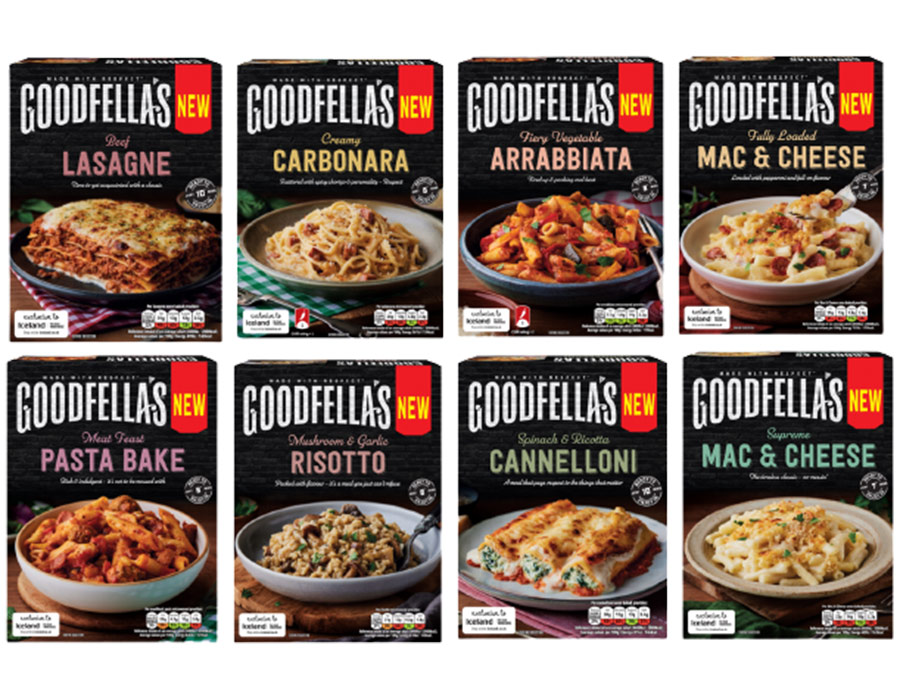
Introducing, a brand-new range to the Goodfella’s family, eight mouth-watering frozen ready meals, launching exclusively in Iceland from the end of August.

Each meal has been inspired by the rich and comforting flavours of Italy, ensuring the best authentic ingredients are picked to deliver flavoursome meals that are made with Goodfella’s trademark respect. All recipes hit the Goodfella’s high standards of quality to ensure the generous portions are nutritionally balanced and low in salt, whilst bursting with flavour.

The new Goodfella’s ready meals are perfect for those busy weekdays as each meal has been crafted with ease and convenience in mind, and can be oven-cooked in 30-35 minutes or microwaved in just 10 minutes.

The eight Italian inspired recipes include:

  • Beef lasagne: the rich lasagne uses the finest Italian fresh egg pasta, as well as authentic Grana Padano and pecorino cheese
  • Creamy carbonara with chorizo: made from sizzling Chorizo and three delicious cheeses, including cheddar, mozzarella and regatta cheese
  • Fiery Veg Arrabbiata: briming with a range of colourful veggies from sun dried tomatoes to roasted courgette
  • Fully loaded mac & cheese: loaded with succulent pepperoni and topped with golden brown breadcrumbs and cheese
  • Meat feast pasta bake: the meat feast bake is made with top quality bacon, pepperoni, and meatballs which ooze smoky flavours
  • Mushroom and garlic risotto: using a range of delicious mushrooms, including whole Oyster, Nameko, Shiitake and Dice Porcini
  • Spinach and ricotta cannelloni: complete with the finest Italian ingredients, including fresh egg pasta
  • Supreme mac & cheese: made with a generous serving of pasta, sprinkled with golden breadcrumbs and cheese


Alex Brown, Brand Manager at Goodfella’s, says: “We’re so excited to offer shoppers our brand new ready meals, we’ve gone back to our roots with a new range of Italian-inspired meals that bring generous and distinctive recipes to the shelves.

We’ve seen a huge demand in shoppers wanting high quality ready meals that are tasty but also brilliant value for money, the new Goodfella’s range will aim to offer excellent quality meals at a competitive price.”

The full Goodfella’s ready meal range packaging is fully recyclable and each meal is excellent value with an MRSP of £3.00 individually or 2 for £5.00. available in Iceland nationwide from the end of August.

ICELAND AND UTILITA HELP FAMILIES HEAT AND EAT, WITH COST OF LIVING SAVINGS OF UP TO £604 EVERY YEAR

Households reliant on oven cooking could save up to £604 per year by switching to a more energy efficient cooking methods, according to new research by energy supplier Utilita. Joining together with frozen food specialist Iceland, the pair are embarking on a first of its kind partnership, that aims to help those struggling with the rising cost of living, by offering practical solutions and advice on how to save money.

As the UK anticipates one of the most expensive winters in its history, Utilita and Iceland’s ‘Shop Smart, Cook Savvy’ collaboration will officially launch in early September to help families better understand the cost of cooking, and to help identify the most economical cooking methods available to them to make budgets stretch further.

As part of the joint campaign, both brands have committed to 11 pro-consumer, pro-planet pledges in total, which includes a massive overhaul of Iceland’s own-product packaging to reflect more energy efficient cooking appliances and methods, and a national ‘Cooking High 5’ consumer awareness tour, facilitated by Utilita outside Iceland stores.

The launch will also see the introduction of both brands selling the best value 4.5l air fryer on the market from Tower Housewares retailing at the discounted price of £35, enabling consumers to make their investment back in around 47 days of avoiding the oven. Air fryers will be sold at Iceland stores nationwide and online at www.iceland.co.uk, and at Utilita’s High Street Energy Hubs.


Changing Cooking Behaviour

 The research presents the cost to cook, per minute for each of the main types of cooking appliance. It also explores a range of common cooking methods and offers recommendations on how to change their behaviour to save. Households spend approximately 43 minutes cooking each day and almost half (42%) admit to using the oven by default for the main part of their cooking needs. More than half of UK households admitted to not knowing which of their cooking appliances cost more to run (52%).

Utilita’s in-depth research presents a list of the main seven types of cooking appliances, starting with the most energy intensive – the electric cooker – and finishing up with the most economical to run – the microwave. In anticipation of the list becoming every household’s go-to cooking calculator, the research has been based on the energy consumption of 92 appliances across 24 sources, including academic research, legislation, and data collected from popular shopping websites.[1]

The ‘Shop Smart, Cook Savvy’ research reveals how the cost of cooking can be cut by up to 60-90%[2], enabling households to save hundreds of pounds each year. The research also highlights the wider environmental impact of households’ cooking behaviours, revealing that oven default households could avoid generating the same amount of carbon emissions generated by driving 1,164 miles in the average car.

The table below shows the cost of using each appliance for the average daily amount of time, and the amount of carbon generated by each appliance per year.[3]


APPLIANCE COST PER DAY TO RUN COST PER WEEK TO RUN COST PER MONTH TO RUN COST PER YEAR TO RUN COe EMISSIONS (equivalent miles driven in avg car)
Electric cooker 87p £6.09 £26.38 £316.54 609
Dual cooker (part electric, part gas) 72p £5.08 £22 £264.03 609
Gas cooker 33p £2.32 £10.07 £120.83 611
Slow cooker 16p £1.15 £4.98 £59.76 115
Air fryer 14p £1.01 £4.40 £52.74 102
Microwave 8p 58p £2.50 £30.02 58


Bill Bullen, Utilita Founder and CEO, said: “For as long as we can remember, our kitchens have been designed around the oven being the main cooking method, which isn’t the case for many households today. Much more economical cooking appliances such as air fryers, slow cookers and microwaves have become increasingly more popular. However the cooking instructions on food packets haven’t reflected this. 

“Utilita and Iceland are closely aligned in our mission to help households make their money go further. There are so many factors that neither Richard or I can control today, but the cost of cooking is mutual ground that we can help consumers with. This unique partnership will hopefully urge other supermarkets to do the same and help consumers choose the most economical cooking methods.”

Richard Walker, Iceland’s Managing Director, said: “The cost of living crisis continues to be the biggest national issue facing consumers and as a private, family-run business, we’re constantly looking at both short, and long term initiatives that can offer any support. 

Our ‘Shop Smart, Cook Savvy’ collaboration with Utilita is so important, as it shines a light on the relationship between what we buy and how much energy we use cooking it, helping to empower our customers and provide them with access to information that can help stretch their budgets further.”

Archie Lasseter, Utilita’s Sustainability Lead, comments: The rising cost of energy is going to create seismic shifts in consumer behaviour associated with energy consumption through a new awareness of the cost to consume. The impact will be far greater than any of the Government’s green initiatives ever could have achieved. 

“Although cooking is said to account for four percent of the average energy bill, the savings speak for themselves.[4] It’s vital that consumers are given the facts they need in order to use less energy in the interest of the pocket and the planet. 

“As experts in energy behaviour change, we know that consumers need to know in pounds and pence what their actions will save them, and we know that every household budgets differently, hence the daily, weekly and monthly cost savings set out in this campaign.”

David Buttress, former CEO of Just Eat and New Cost of Living Business Tsar comments on the campaign:

“This is the type of consumer awareness campaign that will stick in our minds, because it’s enabling every household to rethink the way we cook, which hasn’t been done before. We are delighted to list both Utilita and Iceland as official Help for Household partners for their efforts in enabling and assisting consumers to make impactful savings that will make a big difference, whilst reducing carbon emissions. I am hopeful that other supermarkets will follow suit to help their consumers identify the cheapest way to cook.”

Shop Smart, Cook Savvy Workshops

As part of Utilita’s national education programme, Iceland customers and all households will be invited to attend thousands of free workshops on the 15 ways to cut energy bills by hundreds each year, including five ways to save up to £604 when cooking.


Cooking behaviour Cost saving Carbon saving (miles)
Use more energy efficient appliances


£287 553
Batch cook, when possible £158 305
Use the right size pan with a lid £72 139
Simmer rather than boil £68 131
Don’t overfill the kettle £19 36
Total £604 1164


[1]  A Review of The Energy Intensity of Cooking Appliances and Cooking Practices – Implications for The Cost of Cooking – Archie Lasseter for Utilita 16/08/2022

[2] Gas cooker versus air fryer is 61% saving / electric cooker vs a microwave is 90% saving

[3] Based on cookers being in use for 43 mins per day on average (Utilita and Iceland conducted a survey of 2,000 households across the UK from 26.05.2022 – 31.05.2022 via Onepoll), and all other listed appliances being used for 20 minutes.

[4] Energy Savings Trust – June-21 household energy bill/consumption split

EU GIVES UK MORE TIME TO RESPOND TO ENFORCEMENT ACTION ON NORTHERN IRELAND PROTOCOL

The EU has given the UK an extra month to respond to legal action it launched after the publication of the Northern Ireland Protocol Bill was introduced to parliament on 13 June.

The Guardian reported that at the UK’s request the EU has granted an extension for the deadline to respond to infringement proceedings issued on 15 June.

With a previous deadline of 15 August, the EU has now extended this into September.

The EU’s legal actions came after the UK government’s move to unilaterally modify the NI Protocol via the bill.

Three infringement cases

The Guardian notes that the UK is facing seven total infringement proceedings relating to the protocol.

As covered previously by the IOE&IT’s Daily Update, the June proceedings are related to:

  • A first set of legal proceedings related directly to the UK’s purported failure to comply with “significant parts” of the protocol
  • A second proceeding related to the grace periods the UK unilaterally extended last year to SPS goods moving into NI from GB
  • The third complaint was that a claim that the UK had failed to provide real-time access to UK data on trade movements required under the protocol

These are separate from other legal proceedings, launched on 22 July, regarding the UK’s alleged failure to carry out border checks on goods heading from Northern Ireland to Great Britain NI to GB, as well as its purported failure to implement EU rules on excise, duty and VAT on e-commerce.

NI Protocol Bill: next steps

The bill has cleared the House of Commons and currently sits in the House of Lords, with the government hoping to pass the bill by the end of this year.

The BBC reports that the bill faces a potential rough ride in the Lords once parliament returns from recess on 5 September.

‘Top priority’

As the Conservative Party leadership race continues into August, Ulster Unionist Party leader Doug Beattie MLA, which has historical ties to the UK Conservative Party, has said that dealing with the protocol should be one of the next prime minister’s top priorities, according to The Newsletter.

“As soon as the … leadership campaign is over, we need to see an end to the diplomatic ‘whataboutery’ over the NI Protocol between the EU and the UK government,” Beattie said.


FSA FLAGSHIP SURVEY REVEALS HOW WE ALL EAT TODAY

The FSA have recently published a report which measures self-reported knowledge, attitudes and behaviours related to food safety and other food issues amongst adults in England, Wales and Northern Ireland twice a year.

The latest survey was conducted between October 2021 and January 2022 and provides rich and high quality data on what people think, feel and do when it comes to food.

Emily Miles, Chief Executive at the FSA, said:

‘As well as giving us an important insight into the FSA’s core responsibility of food safety, Food and You 2 also provides us with a detailed snapshot of peoples’ perceptions and behaviours on food-related issues, including sustainability, food security, and their diets.

‘The FSA’s new strategy committed it to helping the governments we serve in Westminster, Wales and Northern Ireland to ensure food is healthier and more sustainable, as well as being safe and what it says it is. This insight is part of the evidence we provide so that consumers’ perspectives on the food they eat are heard.’

The top three food-related concerns amongst consumers in England, Wales and Northern Ireland are food waste, the amount of sugar in the food and animal welfare.

Key findings 

Confidence in food safety, authenticity and the food supply chain  

  • Most respondents (92%) reported that they were confident that the food they buy is safe to eat and more than 8 in 10 (86%) respondents were confident that the information on food labels is accurate
  • Around three quarters of respondents (76%) reported that they had confidence in the food supply chain
  • Respondents were more likely to report confidence in farmers (88%) and shops and supermarkets (85%) than in takeaways (61%), and food delivery services (45%)

Concerns about food  

  • Most respondents (86%) had no concerns about the food they eat
  • When prompted, the most common concerns amongst all respondents were food waste (63%), the amount of sugar in food (59%) and animal welfare (56%)

Food security  

  • Across England, Wales, and Northern Ireland, 82% of respondents were classified as food secure (70% high, 12% marginal) and 18% of respondents were classified as food insecure (10% low, 7% very low)

Eating out and takeaways 

  • Around half of respondents had eaten food in a restaurant (53%), from a café, coffee shop or sandwich shop (either to eat in or to take out) (52%) or ordered a takeaway directly from a takeaway shop or restaurant (50%) in the previous 4 weeks
  • Over a third of respondents had eaten food from a fast-food outlet (either to eat in or take out) (38%) or ordered a takeaway from an online food delivery company (for example, Just Eat, Deliveroo, Uber Eats) (35%) in the previous 4 weeks
  • Most respondents (89%) had heard of the FHRS and around 4 in 10 (41%) respondents reported checking the food hygiene rating of a business in the previous 12 months

Food allergies, intolerances and other hypersensitivities  

  • Just over 1 in 10 (12%) respondents reported that they had a food intolerance, 4% reported having a food allergy, and 1% reported having coeliac disease
  • Of the respondents who reported having a food allergy, the most common foods reported as causing a reaction were peanuts (26%) and fruit (24%)
  • Of the respondents who reported having a food intolerance, the most common foods reported as causing a reaction were cow’s milk and products made with cow’s milk (41%) and cereals containing gluten (19%)

Eating at home 

  • Over two thirds (69%) of respondents identified the use-by date as the information which shows that food is no longer safe to eat
  • Around two-thirds (67%) of respondents reported that they always check use-by dates before they cook or prepare food
  • Over half of respondents (56%) reported that they never wash raw chicken, whilst 40% of respondents wash raw chicken at least occasionally

Food shopping: sustainability and environmental impact  

  • Half (50%) of respondents thought that eating less processed food and 47% thought that minimising food waste contributed most to someone having a sustainable diet
  • Most (59%) respondents thought that buying locally produced food or food that is in season contributed most to someone making sustainable food shopping choices

Sustainable diets, meat alternatives and genetic technologies  

  • The most common changes respondents reported making in the previous 12 months were eating less processed food (40%) and starting to minimise food waste (40%)
  • Around a third (32%) of respondents reported that they currently eat meat alternatives, 21% of respondents reported that they used to eat meat alternatives but no longer do and 39% of respondents reported that they had never eaten meat alternatives
  • Respondents reported greater awareness and knowledge of genetically modified (GM) food (9% had never heard of GM food) than gene-edited or genome-edited food (GE) (42% had never heard of GE food)

Awareness, trust and confidence in the FSA 

  • Around three quarters (77%) of respondents who had at least some knowledge of the FSA reported that they trusted the FSA to make sure ‘food is safe and what it says it is’

The full Wave 4 report is available here.

LATEST RESEARCH SHOWS THE REVISED LAWS FAIL TO DETER DRIVER PHONE USE

Almost half of drivers that took part in a recent survey thought it was “fine” to use a phone behind the wheel, despite major changes to the law earlier this year.

The new rules, which came into force on 25 March, make it illegal for a driver to handle a phone in virtually all circumstances when driving.

Research from Nextbase found that almost 50% of drivers believe it’s fine to use your mobile phone whilst driving, while one in ten (11%) think it’s acceptable to answer a video call while driving, and 7% reveal that they use their phones to watch videos including TV series during long journeys.

Two-out-of-five respondents to a Fleet News poll (42%) said they were not aware the Government was updating the legislation, while a further one-in-20 (5%) knew the law was being tightened, but thought it was not happening for six months or more.

The dashcam provider warns that repeated lockdowns and the pandemic’s impact on our social habits is leading to a “crisis” on our roads, as people are increasingly willing to engage in reckless or outright dangerous behaviour whilst driving.

Bryn Booker, head of road safety at Nextbase, said: “With more people returning to the roads post pandemic there are many changes to regulations, and we implore drivers to make sure they are aware of the latest changes.

“The continued use of technology whilst driving is worrisome, and the latest regulations are looking to crack down on these driving behaviours in order to further reduce the risk for road traffic incidents.”

Further research on bad driving habits picked up during lockdown revealed that 61% of UK drivers believe they are ‘COVID Drivers’, one in five (22%) said they now steer one-handed, 12% confessed to getting easily distracted when driving, while 15% said they drive far too quickly. Nextbase also found that 11% of drivers still believe it is fine to drive after having a drink if ‘you feel fine to drive’.


STARK REMINDER TO BFFF MEMBERS EMPLOYING CONTRACTORS TO ENSURE REGULAR MONITORING AS UK RETAILER B&M WAS RECENTLY FINED £1 MILLION

The Federation encourages its members to review their processes for ensuring contractor safety. This includes employing competent contractors, monitoring contractors, permits to work for high risk work and lock out/tag out procedures for electrical work. In addition, we would also advise members to revisit the sentencing guidelines 2016.

UK Retailer B&M was recently fined £1 million after contractor electrician suffered serious burns in warehouse explosion in Liverpool. In this case the Electrical contractors working methods fell well short of the required standards. Electrical work commenced without proper planning and power supply was not isolated with no controls to factor out human error (switching on supply). With live working allowed to take place, this putting workers at risk of electric shock. The injured contractor suffered serious burns to 15 per cent of his body when he was caught in an explosion. B&M Retail Ltd pleaded guilty to breaching Section 2 (1) and Section 3 (1) of the Health and Safety at Work etc. Act and was fined £1,000,000.

To interpret this, we have provided the below simplistic explanation on the Health & Safety at Work Act and how it applies to those employing contractors:

Section 2 (1) this relates to those employing contractors, with the contractor working in an unsafe manner, this was clearly putting own employees at risk and therefore a breach of their duty.

Section 3 (1) this relates to those employing contractors and ensuring they are not exposed to any risk. As an employer of contractors you must ensure they are competent ones and have a robust system in place to monitor them. This does not mean controlling their work but stopping their work if unsafe (such as no lock out tag out procedures).

The contractor also pleaded guilty to breaching Section 2 (1) of the Health and Safety at Work Act and fined £100 for the failure to protect their own employees. For the contractor there is a clear role defined for supervising employees. Full the full story please see below link:

Retailer and electrical contracting company fined after electrician sustains serious burns in warehouse explosion | HSE Media Centre

Sentencing Guidelines 2016

With the sentencing guidelines coming into play in 2016 there is a duty for the employer toward its employees and non-employees. You will notice huge a huge difference in the fine for B&M (£1 Million) and the contractor (£100), this due to differences such as turnover. The sentencing guidelines provide a structured approach for a judge passing sentence, this considers many variables however the main key areas are as follows:

  • Culpability – This is a comparison to find out how far the company was from complying with the law, this stated as low, medium, high or very high.
  • Harm Category – This section considers both the seriousness of harm risked by the offender’s breach categorised (A, B & C) and the likelihood of harm (Low, Medium or High). It is important to remember this category is determined by potential for harm rather than actual harm.
  • Company turnover – Once the levels of culpability and harm are established. The company size and turnover are established. Large over 50 million, Medium Turnover £10-50 million, Small turnover £2-10 million, Micro turnover up to £ 2million.

An example based of the sentencing guidelines would be a client employing a contractor to work at height. The contractor using inadequate access equipment to work at height with no safe system of work. Contractor falls from height resulting in a fractured knee cap. Incident is reported under RIDDOR and HSE or local authority investigate to find a material breach. Starting level for fine for large turnover company over 50 million turnover is £800,000 this could up to maximum of £3.25 Million.

See below full sentencing guidelines, please see below link:

Organisations: Breach of duty of employer towards employees and non-employees/ Breach of duty of self-employed to others/ Breach of Health and Safety regulations – Sentencing (sentencingcouncil.org.uk)

Member Benefits

Exclusive Partnership deals on key products and services:

  • BFFF energy deals and rates
  • Vypr member deals and introduction
  • Defib Plus deals
  • Company Shop – membership
  • Mentor – MHE training health check

Exclusive access to networking opportunities and events:

  • Meet the Buyer events (retail & foodservice)
  • Annual Business Conference with networking dinner
  • Specialist H&S and Technical Conferences
  • Special interest groups (packaging, frozen food temperatures)
  • Annual Lunch
  • Awards Night
Upcoming Events More Events
Sponsorship Packages

We offer a range of sponsorship opportunities to BFFF members across our events throughout the year, with flexible packages that can be tailored to suit your business objectives.

Contact Us
British Frozen Food Federation Members Logo
what our members say...
  • Wakefield Council

    “What an amazing piece of work and indicative of how BFFF respond to the concerns of their members and make an impact on the whole industry sector.”

    See Full Quote

  • Sysco

    “You guys really ‘Do The Right Thing’ for the good of the industry”

    See Full Quote

  • Darta

    “The BFFF awards night is becoming an “appointment not to miss” on our calendar and we again enjoyed it immensely together with lots of well-known people from our industry. The…

    See Full Quote

  • Kantar Worldpanel

    “The Business Conference was an excellent day that was very well organised and allowed so many likeminded individuals in the room to learn so much more around the Frozen industry….

    See Full Quote

  • Lakeside Food Group Ltd

    “This Not For EU labelling situation alarmed us and quickly became a major worry to our business. These are times when you really rely on some support and from previous…

    See Full Quote

  • Meadow Vale Foods Limited

    “We had a few questions with respect to the new EPR waste packaging legislative changes. I know some of my colleagues have been assisted by BFFF in the past so…

    See Full Quote

  • Newberry International Produce Ltd

    “I am writing to express my heartfelt gratitude for the outstanding event you organised. I have only worked in this sector for the past nineteen months coming from twenty-five years…

    See Full Quote

  • Place UK Ltd

    “The BFFF 2024 Conference was compelling and thought provoking, with a many relevant and interesting topics covered at great pace and some depth by excellent speakers – will certainly attend…

    See Full Quote

  • Roswel Spedition GMBH

    “Thank you and the team for rushing around so brilliantly before, during and after the conference. It was pleasure to be part of the conference.”

    See Full Quote

  • Seara

    “The event was great, in my opinion. Not only it was very well organised, but the venue and the catering were excellent too. Furthermore, the content of the presentations was…

    See Full Quote

Website Designed & Built by we are CODA