Become a member

FROZEN HELPS FOODSERVICE TO SURVIVE UNCERTAIN TIMES

New Frozen Food Report shows how utilising frozen helps outlets cope with fluctuating covers, staff shortages and supply disruptions  

  • Frozen food supports back-to-basics menu approaches
  • Foodservice market expected to reach £95bn in 2022, still 5% below 2019
  • Demand for delivery options expected to remain

The British foodservice sector has been hobbled by successive lockdowns, plummeting consumer confidence and deepening disruption to supply chains during the past two years. But the Frozen Food Report 2022, launched today, says that against this backdrop, frozen food is coming to the fore.

Richard Harrow, chief executive of the British Frozen Food Federation (BFFF) said: “Many foodservice operators found that offering their usual menu was almost impossible on reopening after covid restrictions. Whether due to having fewer kitchen staff or unpredictable diner numbers, many menus were replanned and frozen food offered a solution to several problems.

“The convenience and longer shelf life of frozen is allowing operators to adapt to the uncertainty caused by the pandemic while reducing food waste and helping them hit their sustainability targets.”

The report highlights the ‘back-to-basics’ approach that has been favoured by many operators. Paring down menus means that kitchen skills don’t have to stretch as far. Choosing a frozen version of tricky, labour intensive dishes like beef wellington, southern fried chicken and souffles allows outlets to provide consistent quality with minimal prep time.

Hopes of a Christmas sales boost were dashed with the emergence of the Omicron variant in the last quarter of 2022 which forced thousands of would-be diners into isolation while keeping cautious customers away.

Harrow added: “Restrictions for dining out may have been lifted in summer, but the foodservice sector wasn’t able to recover to reach anywhere near pre-pandemic numbers. Britain now has at least 10,000 fewer licensed premises than it did before the pandemic hit. Our predictions show that the total foodservice market is to reach around £95bn in 2022, which is still 5% below 2019 levels.”

As consumers have developed new habits and preferences, The Frozen Food Report 2022 also predicts that foodservice outlets will still be expected to provide enhanced delivery and take away options.

Harrow said: “Consumers have become more accustomed to food delivery and collection. This element of foodservice will continue to grow. Consumers now expect to be able to get what they want, when they want, and where they want it. This demand has driven innovation in sector tech, for example the OrderPay app works with What3Words to enable foodservice delivery to whichever 3m square space a consumer is in, such as parks, festivals and events.”

He concluded: “Frozen’s proved ability to cut food waste is also going to see it gaining a bigger role in foodservice outlets in response to consumer demands for more sustainable food and operators publicly declared CSR objectives.”

The Frozen Food Report 2022 brings together research from leading names including Kantar Worldpanel and IGD to give a full picture of the market for frozen food. It has been produced by the BFFF Young Leaders Forum, with input from BFFF members, and features opinions and market predictions from industry leaders, including foodservice consultant Peter Backman, founder of FutureFoodservice.com Simon Stenning, and Hugo Mahoney, former CEO of Brakes Group.

Copies of the Frozen Food Report are available from here
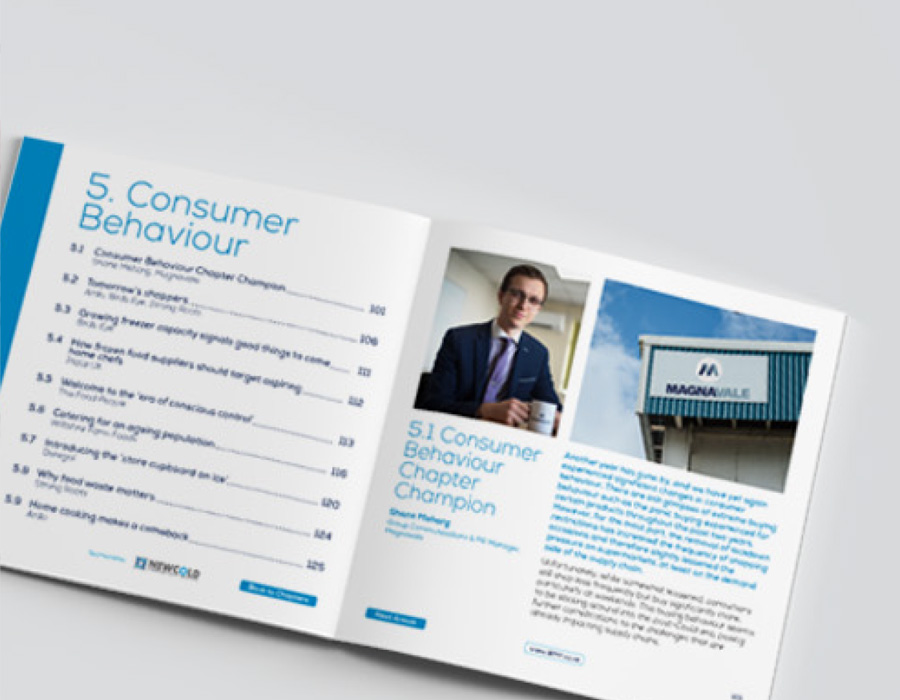
Frozen Food Report Consumer Behaviour Chapter Champion

Consumer Behaviour Chapter Champion
Shane Meharg
Group Communications & PR Manager, Magnavale

“Another year has gone by, and we have yet again experienced significant changes in consumer behaviour. There are still glimpses of extreme buying behaviour such as the panic buying experienced for certain products throughout the past two years. However, for the most part, the removal of lockdown restrictions has increased the frequency of shopping occasions and therefore slightly lessened the pressure on supermarkets, at least on the demand side of the supply chain.

Unfortunately, while somewhat lessened, consumers still shop less frequently but buy significantly more, particularly at weekends. This buying behaviour seems to be sticking around into the post-Covid era, posing further complications to the challenges that are already impacting supply chains.

Demand for frozen food has increased significantly; larger volume shopping occasions mean that frozen is replacing fresh as it keeps much longer. Covid has led to a clear shift towards healthier choices. More people are now more health-conscious and willing to change their lifestyle due to the fear of Covid and future illnesses.

Plant-based products are amongst the largest growth categories, as these tend to freeze very well, and are in greater demand from a customer base that is increasing their consumption of meat alternatives. Shoppers have retained several habits from lockdown; one habit in particular is the size of their shops and the period of time in-between visits. Consumers have been buying more and thus visiting the supermarket less often.

One potentially beneficial way that manufacturers and retailers can respond to this is by adjusting size of packaging. Bulk packs and larger volume items give manufacturers and retailers the opportunity to make a substantial saving on packaging costs while catering to the new demand for bulk buying.

Over the past two years, perceptions have changed significantly in favour of frozen food. The vast majority of food waste comes from private households, which makes it more difficult to address but it’s not impossible; it is self-evident that switching to frozen from chilled will have a positive impact.

Indeed, many studies have concluded that greater reliance on frozen food would deliver a significant reduction in the nation’s environmental footprint, despite the energy required to keep products frozen. “Frozen food does not cause more damaging emissions than their [chilled] counterparts,” concluded one German study.

It continued: “In addition to a comparable climate footprint, frozen food has even more to offer. As a matter of principle, the products are fresh, since vitamins are preserved during the process of shock freezing. Moreover, frozen food is easy to handle and allows portioning in the sizes needed, and thus may help to counteract food wastage.”

It stands to reason, very few meals require a whole broccoli, for example; by simply changing to frozen, the remainder can be kept for months, rather than days, before spoiling. Studies have confirmed this. One concluded: “Frozen food can significantly reduce greenhouse gas emissions for products not produced in the UK year-round.”
What’s more, as use of energy from renewable sources increases, frozen food will see a far greater reduction in carbon emissions relative to that of chilled products, simply because they are stored for longer, and at lower temperatures. Another study found that greenhouse emissions from a typical roast chicken meal comprising frozen ingredients are 3% lower than a comparable meal made with chilled ingredients.

That difference, of course, is not huge. Crucially, emissions arising from waste from the frozen chicken dinner accounted for 31% of the meal’s total emissions, while waste from the chilled meal accounted for 53.3% of its total; emissions from energy made up 67% of the frozen total and 45.6% of the chilled.

Clearly, greater use of renewable energy in the frozen supply chain will widen the emissions gap between frozen and chilled food, in favour of frozen. The development of facilities such as Magnavale’s new cold storage facility in Lincolnshire, which is powered completely by energy from renewable sources, are fuelling the environmental arguments for greater consumption of frozen food.

To convince more people to switch to frozen, the industry must challenge the misconception that frozen food isn’t as fresh or lacks the flavour or nutrient load of chilled foods. Progress is being made as supermarkets and consumers alike increase their freezer space. There are several ways to adapt to the modern requirements of the food supply chain and doing so is crucial. It’s hard to predict what the future holds, but we can be sure that it won’t be a return to the status quo of the pre-covid era.”

The Frozen Food Report 2022

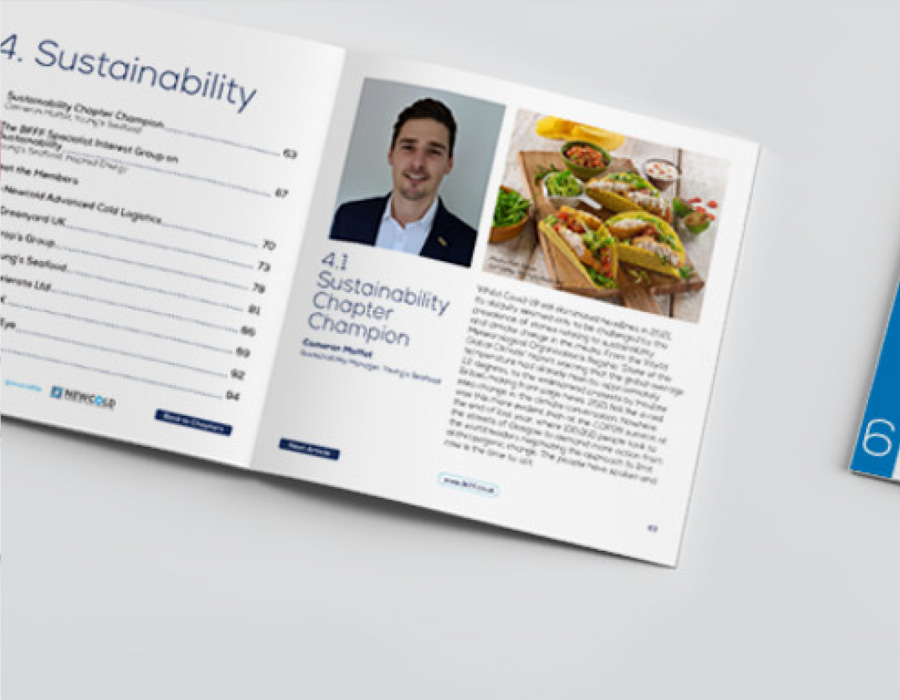
Frozen Food Report Sustainability Chapter Champion

Sustainability Chapter Champion

Cameron Moffat
Sustainability Manager, Young’s Seafood

“Whilst Covid-19 still dominated headlines in 2021, its ubiquity seemed only to be challenged by the prevalence of stories relating to sustainability and climate change in the media. From the World Meteorological Organisation’s flagship ‘State of the Global Climate’ report warning that the global average temperature had already risen by approximately 1.2 degrees, to the widespread protests by Insulate Britain making front page news, 2021 felt like a real step change in the climate conversation. Nowhere was this more evident than at the COP26 summit at the end of last year, where 100,000 people took to the streets of Glasgow to demand more action from the world leaders negotiating the approach to limit anthropogenic change. The people have spoken and now is the time to act.

The British frozen food industry has always had particularly strong messaging relating to production of safe, nutritious goods with minimal food waste. Nevertheless, the manufacturing, storing and transporting of frozen goods is an energy intensive process that needs immediate attention if businesses are going to transition to Net Zero.

This topic remains a huge piece of the puzzle in assuring sustainable food systems both in the UK and its complex global supply chain. Whilst challenges in the availability of accurate and consistent data in this area still exist, businesses are increasingly aware of its necessity and are engaging with the tools needed to transparently report it.

As we look forward to 2030 and beyond, increasingly climate conscious consumers will be looking for the simplest way of reducing their environmental impact. A trend that is set to grow over the next few years is footprint labelling on pack, with detailed recyclability and emissions information influencing buying decisions.

This movement is supported by a recent EY report that noted “Gen Z and Millennials are much more likely to favour sustainable lifestyle choices, such as plant-based diets and use of public transport. They are more likely to share information about products that are good for the planet with their friends and peers”. Businesses in the frozen food space like Quorn have already made headway with this and have shown the possibilities of offering these eco-aware consumers of tomorrow more robust information on the products they are buying.

The term ‘Sustainability’ can mean many different things to many people. From the responsible procurement of raw materials, to the management of water and waste, or the effectiveness of a business’s human rights due diligence procedure. This is why this year’s formation of the BFFF Special Interest Group on Sustainability is a fantastic step forward for the Federation. By using collective knowledge, effectively allocating resources and sharing insight, we will have the ability to better address the holistic challenges our industry faces.

With this being said, I am very proud to be this year’s Frozen Food Report Sustainability chapter champion and I welcome you to read on into the chapter’s insights.”

The Frozen Food Report 2022

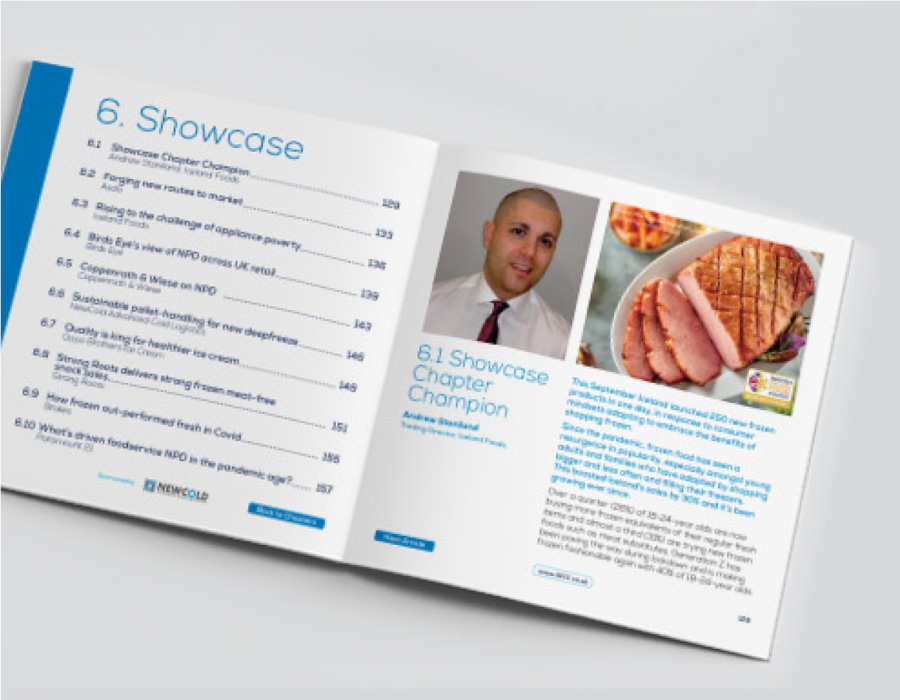
Frozen Food Report Showcase Chapter Champion

Showcase Chapter Champion
Andrew Staniland
Trading Director, Iceland Foods

This September Iceland launched 250 new frozen products in one day, in response to consumer mindsets adapting to embrace the benefits of shopping frozen.
Since the pandemic, frozen food has seen a resurgence in popularity, especially amongst young adults and families who have adapted by shopping bigger and less often and filling their freezers. This boosted Iceland’s sales by 30% and it’s been growing ever since.

Over a quarter (26%) of 18-24-year olds are now buying more frozen equivalents of their regular fresh items and almost a third (31%) are trying new frozen foods such as meat substitutes. Generation Z has been paving the way during lockdown and is making frozen fashionable again with 40% of 18-24-year olds stocking up on more healthy frozen options like vegetables, fruit, meat and fish.

But it is not just families and the younger generation turning their attention to frozen; a third (33%) of all UK shoppers are using their freezer more efficiently and a further one in five (21%) are including more frozen foods in their cooking.

When it comes to why shoppers are re-igniting their love for frozen, the cost saving potential of frozen over fresh has been a huge driving force. One in five (21%) have noticed how frozen items can be better value for money than fresh, and 17% agree they can get far more for their money by shopping frozen.

Our frozen sales have boomed over the past year or so and this has resulted in Iceland introducing its biggest-ever frozen new product development drive outside of Christmas. The frozen industry still must keep pushing on innovation if we want to be taken seriously by the consumer and one way that can be achieved is with association.
Now that shoppers are becoming savvier about the savings they can make by shopping frozen, it’s the industry’s job to keep demonstrating innovation in frozen. This will keep these new customers interested and entice even more to convert from fresh to frozen.

Having a dedicated team and a state-of-the-art development kitchen allows us to keep improving and keep innovating for Iceland own brand and for others. Here we can offer the major players a service that enters them into the frozen market. Customers love big brands and when we get brands into the Iceland development kitchen it reaps rewards for us, for the brands and most importantly for customers looking to switch to frozen.

Customers want to see new product regularly. Plotting out new and innovative products throughout the year gets customers excited and keeps them returning. Offering big brands at great prices is a sure way to do this, so when you add exclusivity on brands into the mix, it’s a great recipe for great sales.
Iceland currently has over 200 exclusive products with 20 brands and demand is like no other. The innovation with branded products starts with understanding your customer and what they like to eat, knowing the brands they already like and tapping into their eating habits such as where and when they like to eat out and how adventurous they like to be. Keeping up with the trends – the old, the new and exciting – all helps with the innovation process.

Favourite exclusive products that Iceland develops, such as with TGI Friday’s, allow customers to feel like they are taking the restaurant experience home with them at a fraction of a cost. The most recent brand we have introduced is Piccolino, a luxury Italian restaurant, which is different to our usual offering, but we have listened and understood that the demand for the ‘dine out, at home’ experience is on the up.

The new products that we’ve put in stores recently have been crucial in driving our strong growth. Being first to market with new, quality and exclusive frozen food products ultimately gives us the footfall we wouldn’t normally have.

The consumer habits embedded during lockdown, coupled with the level of innovation within frozen food, mean that we are entering a particularly exciting period within the category and I’m looking forward to seeing how Iceland, its suppliers and other retailers maximise this over the next twelve months.

Character is revealed by crisis. And in the past two years of pandemic, BFFF’s members have revealed their true characters, adapting to huge shifts in consumer behaviour and using innovative new approaches and products to emerge from this crisis stronger than ever. Here are some of the most compelling stories of innovation in the age of Covid.

The Frozen Food Report 2022

BRAKES INTRODUCES THE FIRST PLANT-BASED MILK PACKAGING

Fully renewable packaging made from sugarcane and paperboard.

Brakes and dairy supplier, Yew Tree Dairy have announced a new initiative that will see the UK’s leading foodservice supplier become the first wholesaler in the country to sell milk in plant-based packaging.

The new Tetra Rex® plant-based carton is the world’s first fully renewable and recyclable beverage carton.  It is made from sustainably sourced paperboard and plant-based plastics derived from sugarcane, accredited to Bonsucro certification for sustainably sourced sugarcane.  Both plants absorb carbon as they grow, removing it from the atmosphere.  Once the sugarcane is harvested, it is crushed and the juice turned into ethanol, which is made into a polymer.

The new packaging is recyclable within the UK. The paper fibres are turned into new paper products and the plant-based plastics are recycled into products such as reusable crates.

Stuart Smith, Merchandising Director at Brakes, said: “We’re committed to supporting our customers to become more sustainable, through the way that we operate and the products that we supply. We were the first wholesaler to remove black plastics and are delighted that we are now the first wholesaler to introduce fully renewable milk packaging.  It demonstrates Brakes’ CSR commitment to sourcing products responsibly, respecting the planet and caring for people and aligns with parent-company Sysco, which has publicly-stated commitments to reduce the waste generated through its direct operations globally.”

Carl Woodcock of family-run Yew Tree Dairies: “We have a very long-standing and exclusive relationship with Brakes in foodservice, where we’ve worked side-by-side for many years.  We’re therefore particularly pleased to be launching this new innovation with them.  Sustainability and transparency are two things which are at the core of our business and the new pack is testament to our commitment in this area.”

Dragan Rajkovic, Sustainability Director at Tetra Pak: “With the microscope firmly on packaging materials, we’ve been delighted to work with Brakes and Yew Tree Dairy to introduce the Tetra Rex packaging for milk.  We have looked at each part of the supply chain to ensure that we have created packaging, which is not only fully renewable, but also stands up to the rigours of the supply chain.”

BIRDS EYE APPOINTS LEADING MARKETEER JIM SHEARER AS NEW MARKETING DIRECTOR

Birds Eye Limited has bolstered its marketing machine with the appointment of former Molson Coors strategy leader Jim Shearer as Marketing Director UK & Ireland, effective from 28th February 2022.

Shearer joins the UK’s leading frozen food company with a wealth of experience and will become a member of Birds Eye’s UK & Ireland Board, leading the marketing agenda for the Birds Eye, Goodfella’s and Aunt Bessie’s brands, reporting directly to General Manager for Birds Eye UK & Ireland, Steve Challouma.

Prior to joining Birds Eye, Shearer worked for global beverage company Molson Coors for 17 years, where he most recently led the business’s Strategy, Insight and Innovation team for EMEA & APAC. Within Molson Coors, Shearer was also Marketing Director UK & Ireland for several local and global brands, including Carling, Coors Light and Aspall’s Cider.

His work and marketing influence has also been recognised within the industry, having appeared in Campaign Magazine’s Power 100 list for three consecutive years from 2018, reflecting his prowess in the field.

Commenting on his new role Shearer, who replaces former Marketing Director Sarah Koppens, said: “I know I am joining a business that, as category leader in the UK & Ireland, rightfully has high expectations to meet from its customers and consumers alike. I have an incredible amount of energy to rise to that challenge and continue to push the category leadership standards that the business has been at the forefront of for many, many decades.

“I could not be more excited to be joining such a progressive organisation, its iconic brands and impressive portfolio. The business’ commitment to building its brands and a more sustainable future is impressive, as is the determination of its people to do just that. It is a privilege to be part of the business’ next vibrant chapter, as it continues to innovate against the brief of feeding families more healthy, nutritious and great tasting food in the future.”

Steve Challouma, General Manager UK & Ireland – Birds Eye Ltd, commented: “Jim brings a breadth of multi-functional expertise to his new role, giving him a broad understanding of how businesses such as Birds Eye operate. Jim has joined at an exciting time for Birds Eye as we continue to turn the dial on our distinctive frozen food campaigns and launches in the UK to maintain category leadership. Frozen food has never been more relevant for modern day consumers and their lifestyles, and as we continue to grow our business, Jim will play a key role in taking our brands forward with the exciting initiatives and products we have coming up.”

Member Benefits

Exclusive Partnership deals on key products and services:

  • BFFF energy deals and rates
  • Vypr member deals and introduction
  • Defib Plus deals
  • Company Shop – membership
  • Mentor – MHE training health check

Exclusive access to networking opportunities and events:

  • Meet the Buyer events (retail & foodservice)
  • Annual Business Conference with networking dinner
  • Specialist H&S and Technical Conferences
  • Special interest groups (packaging, frozen food temperatures)
  • Annual Lunch
  • Awards Night
Upcoming Events More Events
Sponsorship Packages

We offer a range of sponsorship opportunities to BFFF members across our events throughout the year, with flexible packages that can be tailored to suit your business objectives.

Contact Us
British Frozen Food Federation Members Logo
what our members say...
  • Wakefield Council

    “What an amazing piece of work and indicative of how BFFF respond to the concerns of their members and make an impact on the whole industry sector.”

    See Full Quote

  • Sysco

    “You guys really ‘Do The Right Thing’ for the good of the industry”

    See Full Quote

  • Darta

    “The BFFF awards night is becoming an “appointment not to miss” on our calendar and we again enjoyed it immensely together with lots of well-known people from our industry. The…

    See Full Quote

  • Kantar Worldpanel

    “The Business Conference was an excellent day that was very well organised and allowed so many likeminded individuals in the room to learn so much more around the Frozen industry….

    See Full Quote

  • Lakeside Food Group Ltd

    “This Not For EU labelling situation alarmed us and quickly became a major worry to our business. These are times when you really rely on some support and from previous…

    See Full Quote

  • Meadow Vale Foods Limited

    “We had a few questions with respect to the new EPR waste packaging legislative changes. I know some of my colleagues have been assisted by BFFF in the past so…

    See Full Quote

  • Newberry International Produce Ltd

    “I am writing to express my heartfelt gratitude for the outstanding event you organised. I have only worked in this sector for the past nineteen months coming from twenty-five years…

    See Full Quote

  • Place UK Ltd

    “The BFFF 2024 Conference was compelling and thought provoking, with a many relevant and interesting topics covered at great pace and some depth by excellent speakers – will certainly attend…

    See Full Quote

  • Roswel Spedition GMBH

    “Thank you and the team for rushing around so brilliantly before, during and after the conference. It was pleasure to be part of the conference.”

    See Full Quote

  • Seara

    “The event was great, in my opinion. Not only it was very well organised, but the venue and the catering were excellent too. Furthermore, the content of the presentations was…

    See Full Quote

Website Designed & Built by we are CODA