Become a member

STAR REFRIGERATION WINS PARTNERSHIP AWARD WITH ASDA AND CITY FM AND IS NAMED REFRIGERATION CONTRACTOR OF THE YEAR AT THE TCS&D AWARDS 2021

The TCS&D Awards 2021 took place on 7th September 2021 as part of the TCS&D Show, and Star Refrigeration were announced as double winners. The awards ceremony took place at the East of England Arena in Peterborough and attracted hundreds of businesses and professionals in the TCS&D industry.

The event celebrates individuals and businesses making a difference in the temperature controlled storage and distribution industry. Star was awarded with the sought-after prize – Refrigeration Contractor of the Year. As a pioneer in natural cooling and heating technology, the company has a long trajectory helping the sector reduce its carbon footprint and transition to net zero.

Dr Rob Lamb, Group Sales & Marketing Director, said “We’re really proud to be walking away with not one but two awards from this prestigious ceremony.”

“Our team work incredibly hard to service the TCS&D industry so we are thrilled to be recognised as Refrigeration Contractor of the Year. We have also enjoyed showcasing how our energy optimisation software, Ethos, can cut carbon emissions for customers such as Asda who has been recognised in the Partnership Award.”

Star’s unrivalled knowledge of the TCS&D industry and unwavering commitment to its customers has been fundamental in achieving refrigeration related carbon targets for many owners and operators of cold stores. Asda, one of the UK’s largest supermarket chains, owns nine chilled distribution centres and thanks to an initiative between Star Data Analytics, City Facilities Management has now saved over 5 GWh of electricity and 1,100 tonnes of CO2e.

This significant reduction has been achieved by installing Star’s innovative data monitoring technology, Ethos. It was piloted at one of Asda’s CDCs, and proving successful in reducing energy usage, it was then installed at all of the sites.

Ethos is a bespoke data driven analysis software. It measures the energy gap between how the plant performs and how it should perform at optimal conditions. It can then suggest corrective actions to reduce energy usage to meet environmental goals as well as provide estimates on costs and savings.

Asda is the first supermarket to use this data-led digital twin technology across all their estates. Through focusing on energy optimisation and reduction, the company has driven down its property related CO2 emissions by 43% since 2015.

Anna Flanagan, Business Development Manager at Star Data Analytics, said, “We can all agree that industry and businesses must do more to drive down carbon emissions. Partnerships like this are a fine example of how this can be achieved.”

To find out more about Star and the Ethos software go to https://www.star-ref.co.uk/service-categories/data-monitoring/

To find out more about the collaboration between Asda, City FM and Star go to https://www.star-ref.co.uk/case-studies/storage-distribution/asda/

NEW BFFF INITIATIVE TO SUPPORT INDUSTRY THROUGH BREXIT ‘PAIN POINTS’

To address the ongoing issues caused by Brexit, The British Frozen Food Federation (BFFF) has announced the launch of a series of new resources to support the industry.

These include a signup mailbox for Brexit alerts available to both members and non-members, through which the BFFF will send out alerts as and when it receives pertinent information from government or other forums.

In addition, a series of support sessions are being planned which will support members and the wider industry in easing the current ‘pain points’ caused by Brexit.

The next support session – ‘Brexit eight months in: Transport and Groupage Support Session’ – takes place on Tuesday 21 September at 10am. The BFFF will be joined by Peter Bambury from Roswel Spedition Gmbh and Robert Hardy, operations director at EORI UK. They will share best practice case studies and provide advice on how to prepare for what’s to come.

Further support content courtesy of technology-based freight forwarder Unsworth will follow in October.

Non-members can attend online events live, but full BFFF members will have exclusive access to additional expert guidance, further articles and full recordings in the BFFF webinar library.

Richard Harrow, chief executive of BFFF, said: “As issues surrounding our exit from the EU continue to cause disruption there are more questions than answers coming out of government. We recently held a round table with members which uncovered some shocking problems arising from Brexit. While most of those who took part are being affected by the well-documented driver shortage, food businesses are also struggling to fill managerial and skilled technical positions, as well as facing increased shipping costs.

“It is time for government to recognise that in order to fuel a post-Covid economic boom, the food industry must have access to an available workforce in all areas of the supply chain. As a Federation we want to support our members and the whole industry as much as possible by sharing knowledge and providing a platform to ask questions about the latest government changes and advice.

“Our team works closely with multiple forums and working groups which address many issues relating to Brexit, and as such have immediate access to the most up-to-date information. I think this will prove an incredibly useful tool as we continue to navigate Brexit.”

For more information and Brexit support, visit https://bfff.co.uk/brexit-hub/post-brexit-support-series/. To register for Septembers webinar, go to https://bfff.co.uk/event/brexit-8-months-in-transport-and-groupage-support-session/

THE ESSENTIAL COLD STORAGE GUIDE: CONDENSATION AND FROST PROBLEMS

As one might expect, various forms of water can cause some of the biggest problems with cold chain integrity and worker safety. When warm air infiltrates cooler environments, condensation – and in some cases, frost – can develop.

Condensation and frost on the floor can cause safety hazards inside the facility for workers who might slip. Furthermore, condensation can lead to diminished product quality and compromise the safety of food and pharmaceuticals. Cold storage facilities can’t simply cite building defects as an excuse and are expected to comply with legislation and best-practice by finding verifiable and documentable solutions to frost and condensation build-up.

Frequently called “sweating slab syndrome”, condensation forming on the ground is a common problem in facilities with concrete floors. This usually happens due to warmer air entering through open loading dock doors or gaps between trailers and the perimeter of the dock opening during loading and unloading. Because negative pressure is typical of most facilities, warmer outdoor air (especially in refrigerated/cooler dock areas) typically rushes inside.

Extremely harmful condensation can also form on products that have high water content, like fruits and vegetables, which can cause spoilage. Even products that don’t immediately spoil can be compromised and become harmful to consumers who eat them later. Condensation is a common factor in many listeria cases.

Many facilities combat this problem with environmental seals and shelters at loading dock openings. The most advanced dock shelters can eliminate virtually all gaps along the dock perimeter to minimize air infiltration, as well as any debris or pests.

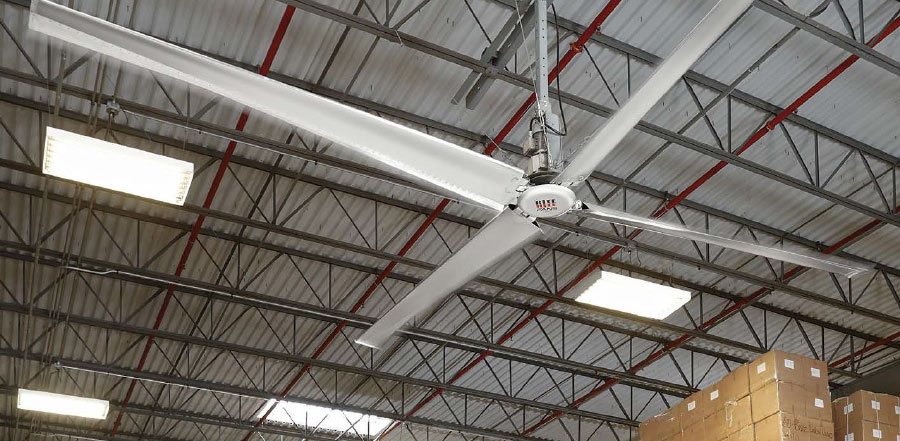
HVLS fans also play a role in mitigating condensation build-up on and near the floor. Through a process called destratification, HVLS fans unify air temperatures from floor to ceiling. An HVLS fan can transform a tall facility with a 8°C difference from ceiling to floor into a single degree. Instead of cool air settling on the ground where warm air can condense, temperature and humidity levels that become uniform diminish condensation development.

Similar to condensation, frost can develop near especially cold areas. It’s not uncommon to find frost near doors and door openings that separate freezers from warmer working areas. This frost can lead to worker safety issues and also increased risk for air infiltration in instances that affect freezer doors closing.

Download the full Essential Guide here

Image: HVLS fans help minimise condensation by creating uniform temperature and humidity levels.

Food Manufacturer Fined after Workers are Exposed to Sulphur Dioxide

A food manufacturing company, based in Holbeach Lincolnshire, has been fined after employees were exposed to sulphur dioxide (SO2) gas released as a result of poor planning and unsafe systems of work during the commissioning and operation of a new potato processing line. 

Lincoln Magistrates’ Court heard that AH Worth Ltd (formerly known as QV Foods Ltd) purchased a new potato processing line in 2018.

The purchased line dipped the cut potatoes into a substance (Microsoak) to prevent them browning. The purchase, installation and commissioning work was poorly planned. During commissioning, the Microsoak gave off sulphur dioxide gas that affected workers in the packhouse. The company made modifications to the line to attempt to cure the problem, but it caused the nozzles on the line to repeatedly block up and more sulphur dioxide to be given off. A maintenance engineer attempting to unblock the nozzles on the 11 June 2018 was badly exposed to the sulphur dioxide. The factory had to be evacuated and other workers in the vicinity were also affected. The maintenance engineer and another worker were so badly affected that they were not able to return to work due to the effects of the gas on their lungs.

An investigation carried out by the Health and Safety Executive (HSE) found that the work should have been properly planned mindful of the risks involved. There should have been adequate flows of information between QV Foods Ltd and the contractors involved. Commissioning should have been properly planned. When they started to have problems, they should have stopped and properly evaluated the solutions before going ahead and modifying the line. The maintenance workers and those on the line should have been provided with adequate information, instruction and training about the new line and what to do. There should have been a safe system of work in place for unblocking the nozzles and the workers should have been provided with additional PPE.

AH Worth Ltd of Manor Farm Holbeach Hurn, Spalding, pleaded guilty to breaching Section 2(1) of the Health and Safety at Work etc Act 1974 in that it failed to ensure, so far as was reasonably practicable, the health and safety at work of its employees. The company were fined £300,000 and ordered to pay costs of £9924.90 with a victim surcharge of £170.

Speaking after the hearing HSE inspector Mr Martin Giles said: “This was a tragic and wholly avoidable incident, caused by the failure of the company to plan properly for the introduction of new plant and equipment. It made alterations to the new plant without adequate thought and planning, failed to implement safe systems of work and failed to react adequately when things started to go wrong”.

HSE – 6th September 2021

SUSTAINABILITY IN THE FOOD SUPPLY CHAIN

With an ever-increasing need to improve the Sustainability in the food supply chain we know many members are focusing on how they can improve their business model in this area.

The Federation is currently supporting two research projects.

The first is by Professor Judith Evans and Professor Toby Peters in investigating the challenges of meeting the 2050 net zero within the cold chain.

The second is being led by a group called the Energy Conscious Organisation in looking at people’s behaviour once a business switches to renewable energy.

Below is a brief summary from each of the projects:

1. The 2050 net zero carbon challenge

The cold-chain is the backbone of our local and global food networks. Conventional cold-chains for food are energy intensive and use refrigerants (which often have high GWPs). How food is delivered has major implications for, rural economies, the food and drinks industry, social well-being, climate change, food security, energy security, and urban air quality. The food and drink industry is the largest manufacturing sector in the UK and the food sector is predicted to increase due to population growth.

London South Bank University, University of Birmingham, Heriot Watt University and Cranfield University are working together to provide a comprehensive evidence driven set of road maps for the UK food cold chain (chilled and frozen) to be able to achieve zero carbon emissions by 2050. The work will assess future cold chain emissions from cooling based on business as usual and identify routes the cold chain can follow to become zero carbon by 2050. The work will encompass both technical and non-technical aspects of decarbonisation.

Ultimately a coordinated strategy will be developed to accelerate the transition to a resilient, decarbonised food cold-chain (chilled and frozen) in the UK. The aim is to develop and deliver a clear industry-led pathway to achieve the UK’s net zero 2050 target whilst maintaining food security and affordability for UK consumers and economic opportunity for the UK food industry. This will be the first detailed road map that will enable the food cold chain industry to identify opportunities to reduce emissions. It will also highlight opportunities and approaches that will enable the UK food industry to remain and become more competitive and provide potential new business opportunities to new actors in the food cold chain. The project will

(i) update and add to current information on energy usage and CO2e emissions from the cold chain;

(ii) assess cooling (chilling and freezing) needs of fresh produce according to their physiological requirements, to maintain quality and safety across the supply chain;

(iii) evaluate future cold-chain and cooling energy consumption demands (from both a technical and non-technical perspective) and the impact on UK energy consumption and peak electricity demand;

(iv) explore through a systems approach how to use (and mitigate), make, store, move, manage, finance and regulate cooling demand through the cold-chain; and

(v) determine areas of intervention considering available energy and thermal resources, emission targets and other commitments as well as costs.

The work will specifically identify how sustainability of the cold-chain system can be increased by taking the following integrated four measures: 1) Reduce: Reducing the need for cooling, ensuring optimal conditions for food in the UK supply chain; 2) Shift: Transitioning to more sustainable technologies and working fluids and taking different approaches to cooling as well as novel energy sources including free, thermal to thermal, waste heat and cold; 3) Improve: Enhance equipment and operation efficiency; and 4) Aggregate: Examine synergies within the cold-chain to better integrate different cooling demands into a single system and enhance thermal symbiosis of cooling systems with heating and other available energy vectors. The analysis will be undertaken from a societal, technical, operational, and economic perspective.

The team involved in the work are keen to connect with industry and so if you are interested in the work and would like to discuss how to become involved, please contact:

Professor Judith Evans: j.a.evands@lsbuac.uk, or

Professor Toby Peters: T.Peters@bham.ac.uk


2. The Energy Conscious Organisation – Research project

Having launched the Energy Conscious Organisation – EnCO – project in conjunction with the Energy Institute in 2019, the Energy Services and Technology Association – ESTA, feels that now is the right time to move forward with an important new research project to further validate the energy savings likely to be achieved by a holistic behaviour change programme. Working with Cranfield University and the University of East Anglia and focusing on the food and drink sector in the UK, the aim of the research is to support the claims of practitioners who have been running behaviour change related energy efficiency programmes for many years of the potential savings that can be achieved. The view of many experts is that savings of up to 50% can be achieved through behaviour change to match the 50% savings from the technological solutions. Whilst an Internationally recognised protocol of measurement and verification has generally been used to support the figures cited it is agreed that robust academic research should provide additional evidence.

The research programme, that will last for three years is being supported by a number of Trade and professional bodies in the UK. It is intended that all interested parties in the project will be supplied with project outcomes and ongoing information throughout the project.

More details about the training and certification programme can be found at www.energyconsciousorganisation.org.uk.

If any member would like more information, then please contact Siobhan. or connect the project leads directly.


UK TRADE AND BUSINESS COMMISSION

Last week I was asked to be a speaker at a meeting of a group called the UK Trade and Business Commission.

The commissioners on the group are drawn from MPs, Business Leaders and Academics. Their purpose is to review the UK’s trading and business environment and to make recommendations to the UK Government for a better future for Britain.

I was joined on the session by Andrew Opie of the British Retail Consortium (BRC) and Alex Veitch of Logistics UK.

The questions were prepared by the various commissioners, and focused on the current shortage of HGV drivers and issues around the wider food supply chain.

It gave me the opportunity to discuss the recent Labour Availability Issue Report of which the BFFF were a co-sponsor. It also gave the opportunity to detail the current impact of cost pressures on the BFFF Membership. Many of my views were supported and indeed repeated by the other two speakers.

The event is an open forum so we were aware a number of civil servants and journalists were present. This resulted in coverage in The Times Business Section and the BBC News Online. However, despite the many calls on the Government for some relaxation on the current Immigration Rules from many sections of the Economy they are not listening.

The one positive from the meeting was that Alex Veitch from Logistics UK felt that with new drivers now passing through the system – Spring 2022 could see the position ease, however, this still means possible issues over the peak Christmas trading period.

Member Benefits

Exclusive Partnership deals on key products and services:

  • BFFF energy deals and rates
  • Vypr member deals and introduction
  • Defib Plus deals
  • Company Shop – membership
  • Mentor – MHE training health check

Exclusive access to networking opportunities and events:

  • Meet the Buyer events (retail & foodservice)
  • Annual Business Conference with networking dinner
  • Specialist H&S and Technical Conferences
  • Special interest groups (packaging, frozen food temperatures)
  • Annual Lunch
  • Awards Night
Upcoming Events More Events
Sponsorship Packages

We offer a range of sponsorship opportunities to BFFF members across our events throughout the year, with flexible packages that can be tailored to suit your business objectives.

Contact Us
British Frozen Food Federation Members Logo
what our members say...
  • Wakefield Council

    “What an amazing piece of work and indicative of how BFFF respond to the concerns of their members and make an impact on the whole industry sector.”

    See Full Quote

  • Sysco

    “You guys really ‘Do The Right Thing’ for the good of the industry”

    See Full Quote

  • Darta

    “The BFFF awards night is becoming an “appointment not to miss” on our calendar and we again enjoyed it immensely together with lots of well-known people from our industry. The…

    See Full Quote

  • Kantar Worldpanel

    “The Business Conference was an excellent day that was very well organised and allowed so many likeminded individuals in the room to learn so much more around the Frozen industry….

    See Full Quote

  • Lakeside Food Group Ltd

    “This Not For EU labelling situation alarmed us and quickly became a major worry to our business. These are times when you really rely on some support and from previous…

    See Full Quote

  • Meadow Vale Foods Limited

    “We had a few questions with respect to the new EPR waste packaging legislative changes. I know some of my colleagues have been assisted by BFFF in the past so…

    See Full Quote

  • Newberry International Produce Ltd

    “I am writing to express my heartfelt gratitude for the outstanding event you organised. I have only worked in this sector for the past nineteen months coming from twenty-five years…

    See Full Quote

  • Place UK Ltd

    “The BFFF 2024 Conference was compelling and thought provoking, with a many relevant and interesting topics covered at great pace and some depth by excellent speakers – will certainly attend…

    See Full Quote

  • Roswel Spedition GMBH

    “Thank you and the team for rushing around so brilliantly before, during and after the conference. It was pleasure to be part of the conference.”

    See Full Quote

  • Seara

    “The event was great, in my opinion. Not only it was very well organised, but the venue and the catering were excellent too. Furthermore, the content of the presentations was…

    See Full Quote

Website Designed & Built by we are CODA