Become a member

Food and Drink Labelling Changes from 1 January 2021

The government has updated the guidance on the labelling requirements for Food and Drink from 1st January 2021. The guidance provides detail for Exporting to the EU as well as Goods sold in Great Britain (GB) and Northern Ireland (NI).

Exporting to the EU

  • Always check with your EU importer to see how the EU’s labelling requirements affect your products.
  • Food of Animal Origin placed on the EU market before 1st January 2021 can continue to circulate without labelling changes.
  • Food of Non-Animal Origin placed on the UK or EU market before 1st January 2021 can continue to circulate both in the UK and EU markets without labelling changes.
  • All food placed on the EU market from 1st January 2021 will have to meet EU rules.
  • Pre-packaged food and caseins must have an EU or NI address for the FBO, or an address of the EU or NI importer on the packaging or food label.
  • You must not use the EU organics logo from 1st January unless:
      • your UK control body is authorised by the EU to certify UK goods for export to the EU
      • the UK and the EU agree to recognise each other’s standards (called ‘equivalency’)
      • Contact your control body to stay up to date.
  • If the UK does not reach an equivalency deal with the EU, you will not be able to export organic food to the EU labelled as organic. However, you can still export the food using non-organic labelling if it meets all other marketing standards and you remove or cover any organic labelling.
  • You will not be able to use the EU emblem on goods produced in GB from 1st January 2021 unless authorisation by the EU has been given.
  • Country of Origin labelling:
    • Food from NI can continue to use ‘Origin EU’
    • Food from GB must not be labelled as’ Origin EU’ from 1st January 2021.
    • Read more about country of origin food labelling.


Goods sold in Great Britain and Northern Ireland

This guidance is subject to the agreement with devolved administrations and Parliamentary process.

  • Goods sold in NI will continue to follow EU rules for labelling, but some labelling changes may be required.
  • All labelling changes required for goods sold in GB must be done by 30th September 2022.
  • Local authorities in GB will be responsible for enforcement of labelling changes
  • Labels can contain other information if you need to comply with labelling requirements for another market.
  • You can continue using an EU, GB or NI address for the FBO on pre-packaged food or caseins sold in GB until 30th September 2022. However, from 1st October 2022, all pre-packaged food or caseins sold in GB must include a UK address for the FBO. If the FBO is not in the UK, include the address of an importer.
  • You are not able to use the EU organic logo on any UK organic food or feed from 1st January 2021 unless:
      • your control body is authorised by the EU to certify UK goods for export to the EU
      • the UK and the EU agree to recognise each other’s standards (called equivalency)
      • You can continue to use your  approved UK organic control body logo in GB.
      • In GB you are required to change the statement of agriculture to ‘UK agriculture’ or ‘UK and non-UK agriculture’.
      • Find out more about trading and labelling organic food from 1 January 2021.
  • Country of Origin labelling:
    • Food that comes from and is sold in NI can continue to use ‘Origins EU’ from 1st January 2021
    • Food that comes from and is sold in GB can be labelled as ‘Origin EU’ until 30th September 2022.
    • From 1st October 2022, food from GB must not be labelled as ‘Origin EU’
    • Read more about country of origin food labelling.
  • For more information and specific labelling rules regarding the following goods Minced Meat, Fruit and Vegetables, Olive Oil, Honey Blends, Beef and Veal and Eggs or Geographical Indication, click here.


To read the guidance in full on Gov.uk, click here.

TECHNOLOGY AND TRACEABILITY

One aspect of food likely to become of increasing interest to the consumer post-coronavirus, and one which is pertinent to both retail and foodservice, is traceability. As consumers start to ask more questions about the origins of what’s on their plate, how can the industry use technology to alleviate food security and traceability concerns?

Thanks to the combined effects of coronavirus and Brexit, people are more concerned than ever about where their food comes from.

As of June 2020, more than 1 million people had signed a petition urging the government to ensure future trade deals do not lead to an increase in imported foods that would be illegal to produce in the UK. In July, Food Standards Scotland (FSS) called on businesses and consumers to be vigilant against the heightened food fraud risks arising from the coronavirus outbreak.

But even prior to the pandemic, manufacturers and retailers were increasing efforts to trace food in a bid to maximise transparency throughout the supply chain. Many began adopting blockchain technology to achieve this and to quickly source information on suppliers.

Blockchain technology is a way of storing and sharing information across a network of users in an open virtual space. It allows users to look at many transactions simultaneously and in real-time. This is especially useful within the food industry, and since transactions are not stored in any single location, it is almost impossible for the information to be hacked.

Blockchain technology also has the potential to boost consumer confidence about the provenance of their plate. By reading a simple QR code with a smartphone, information from an animal’s date of birth, to the use of antibiotics can be sourced within seconds.

But this technology can also help boost productivity.

RiverGlide is helping its client ‘QA Chef’ to develop what it calls a ‘world-leading food-safety and traceability solution’. It says most large-scale non-automated caterers still rely on pen and clipboard, costing man-hours and generating thousands of pages per year with virtually no way to trace items through the production process.

QA Chef uses a combination of hardware and software to produce a digital map of every dish’s food safety journey, from raw ingredients through to your customer’s plate, providing end-to-end traceability of every aspect of the production process.

David Cox, CEO of QA Chef, tells us: “COVID-19 has made consumers more concerned than ever about the safety of the food products they’re buying. Manufacturers have offered reassurances that they are following food safety standards (such as HACCP), but with many large-volume, high-risk caterers still relying on pen-and-paper, they are unable to offer much in the way of proof.

“We are also seeing consumer concerns growing around allergen tracking. While some manufacturers may use ‘alibi labelling’ (e.g. may contain nuts), this does little to help a consumer make the right choices. It’s clear that we need a robust traceability system that can demonstrate compliance from when a product enters a facility until it leaves.”

Jon Shayler, COO of Erudus, agrees. His data sharing business is already seeing an increased consumer appetite for more data in more places, driving new demands and behaviours.

He says: “We’ve had to adapt our platform to include new attributes that dig deeper into a product’s make up, its origins, its accreditations. The industry will need to adapt to these requirements in the future. Consumers are living in a world of choice and opting to vote with their wallets and loyalty, and they’re only going to get more demanding, especially in terms of anything that has an environmental or social welfare aspect.

“At Erudus we believe that the enriched off-pack data and making it easily accessible to both caterers and end consumers, is the future of foodservice.”

Of all the new technologies explored in this series, those which can help guarantee food security are arguably the most important. While the hospitality sector has taken a huge economic hit, the recession now affecting the wider population is likely to create a sharp rise in food insecurity.

Coronavirus has, so far, claimed more than 700,000 lives globally, upended food supply chains, drained food banks and restricted the planting and harvesting of crops. It has also exposed a lack of investment in food technology that could have eased global food security issues.

When considering a post-COVID-19 food system, we must focus on building resilience through technology.

Blockchains will allow agricultural commodities and ingredients to be actively traced throughout the supply chain. It will mean that if production workers fall ill, preceding parts of the supply chain can be reconfigured. Products can also be readily recalled, limiting further spread of the virus. Sensors embedded in packages can also provide quantitative assessments of food spoilage.

As we emerge into a post-coronavirus world, we need to look not only at how technology can keep our businesses open, but also strengthen our supply chains so they are ready to take on the next big challenge.

GUIDANCE ON HEALTH AND IDENITIFICATION MARKS FROM 1 JANUARY 2021

The FSA has released guidance on health and identification marks that must be applied to food products of animal origin (POAO) after the end of the Transition Period. The guidance is for enforcement authorities and UK (Great Britain and Northern Ireland) food businesses that produce POAO.

This guidance outlines the requirements that will enable businesses within the UK producing POAO to place their goods on the Great Britain (GB), Northern Ireland (NI), EU and non-EU markets from the 1st January 2021. There will be further guidance for placing goods on the Northern Ireland Market.

Changes to health and identification marks

At 11pm on 31st December 2020 the current ‘UK/EC’ health and identification mark applied to POAO produced in the UK can no longer be used. New health and identification marks must be used after this date for POAO produced and placed on the GB or NI market or exported outside of the UK.

Adjustment period for changes to identification marks

Legislation in England, Wales and Scotland is being proposed to allow for a 21-month adjustment period for goods placed on the GB market, reducing the impact of the change in requirements for identification marks. The adjustment period will start on 1st January 2021 and run until 30th September 2022.

This will give UK businesses the opportunity to deplete existing stock of packaging or labels carrying the ‘UK/EC’ identification mark owned by the FBO at the end of the transition period. Businesses are encouraged to adopt the new markings as soon as possible once the transition period comes to an end and the adjustment period is not intended to enable businesses to replenish stock carrying the ‘UK/EC’ mark.

The 21-month adjustment period is only available to UK food businesses for POAO placed on the market in Great Britain. It is not applicable to POAO produced in GB and NI for placing on the EU or non-EU markets. There will be further guidance on placing POAO on the NI Market published soon.

Products placed on the market before the end of the EU Transition Period

If your UK business places POAO on a market before the end of the transition period, it will reach the end user using the existing health and identification marks.

  • POAO placed on the market in Great Britain before the end of the transition period can reach the end user on the GB market, including circulation within GB, without re-labelling.
  • POAO placed on the market in the EU before the end of the transition period can reach the end user on the EU market without re-labelling.
  • POAO moved into the EU and Northern Ireland markets from Great Britain after the end of the transition period will require re-labelling to meet new requirements.
  • POAO placed on the market in Northern Ireland before the end of the transition period, can reach the end user on either the UK or EU markets, without the need for re-labelling.

For more guidance on Health and Identification Marks or to see examples, click here

XPO LOGISTICS PROVIDES SAMSUNG CLIMATE SOLUTIONS WITH LAST MILE DISTRIBUTION ACROSS THE UK

XPO Logistics, a leading global provider of transport and logistics solutions, has created a UK distribution solution for Samsung SDS on behalf of Samsung Climate Solutions. The multi-service solution integrates XPO’s last mile transport, warehousing and customs clearance services. Samsung is a global innovator of heating, ventilation and air conditioning (HVAC) technologies, a sector where XPO has extensive experience and national coverage in the UK.

XPO is managing last mile distribution for Samsung from 10 regional hubs by utilising a fleet of 18-ton, tail-lift trucks and sophisticated tracking technology. Samsung’s entire UK stock of air conditioning units is stored at XPO’s warehouse in Crick, Northamptonshire, placing it within next-day delivery range of 95% of UK consumers. XPO provide Samsung and its customers with real-time notification and delivery scheduling on XPO’s Trax app.

Steve Fleming, head of air conditioning – UK and Ireland, Samsung Electronics, said, “We have an industry-leading product range known for excellence, so it’s important that we offer a first-class delivery experience. With XPO as our partner, we can give our customers greater convenience and peace of mind with a next-day option, digital communications and electronic proof of delivery.”

Dan Myers, managing director, transport – UK and Ireland, XPO Logistics, said, “The strong collaboration between Samsung and XPO has been a game-changer for Samsung’s HVAC supply chain in the UK. Drawing on our sector expertise, the team transitioned to the new transport solution and a 60% increase in warehouse capacity in 12 days. Every component of this solution has the flexibility to accommodate our customer’s future expansion.”


About XPO Logistics and XPO Logistics Europe

XPO Logistics, Inc. (NYSE: XPO) is a top ten global logistics provider of cutting-edge supply chain solutions to the most successful companies in the world. The company operates as a highly integrated network of people, technology and physical assets in 30 countries, with 1,506 locations and approximately 96,000 employees. XPO uses its network to help more than 50,000 customers manage their goods most efficiently throughout their supply chains. The company’s corporate headquarters are in Greenwich, Connecticut, USA, and its European headquarters are in Lyon, France. XPO conducts the majority of its European operations through its subsidiary, XPO Logistics Europe, which trades under the stock symbol XPO on Euronext Paris – Isin FR0000052870.

europe.xpo.com


NESTLÉ PROFESSIONAL® AND DAWN FOODS ANNOUNCE LONG-TERM CO-BRANDING COOPERATION IN SWEET BAKERY IN THE EMENA REGION

Nestlé Professional® and Dawn Foods have signed a long-term contract for co-branding cooperation in the EMENA Region (Europe, Middle East & North Africa), partnering in product innovation for a range of sweet bakery products, starting with muffins and cookies. Dawn Foods will create unique recipes and a range of high-quality bakery products, made with ingredients from Nestlé. Both companies see this partnership as a good opportunity to link Nestlé’s most loved confectionery branded ingredients with the top-quality ingredients of Dawn Foods.

“We are delighted about this partnership with Dawn Foods, which will allow us to bring to our consumers new innovative experiences with our confectionery brands. We selected Dawn Foods as our EMENA partner because of the high quality of their bakery products, their capability to convey our brands experiences to the consumers, and their leading position in the sweet bakery industry”, says Vincent de Clippele, Head of Nestlé Professional EMENA.

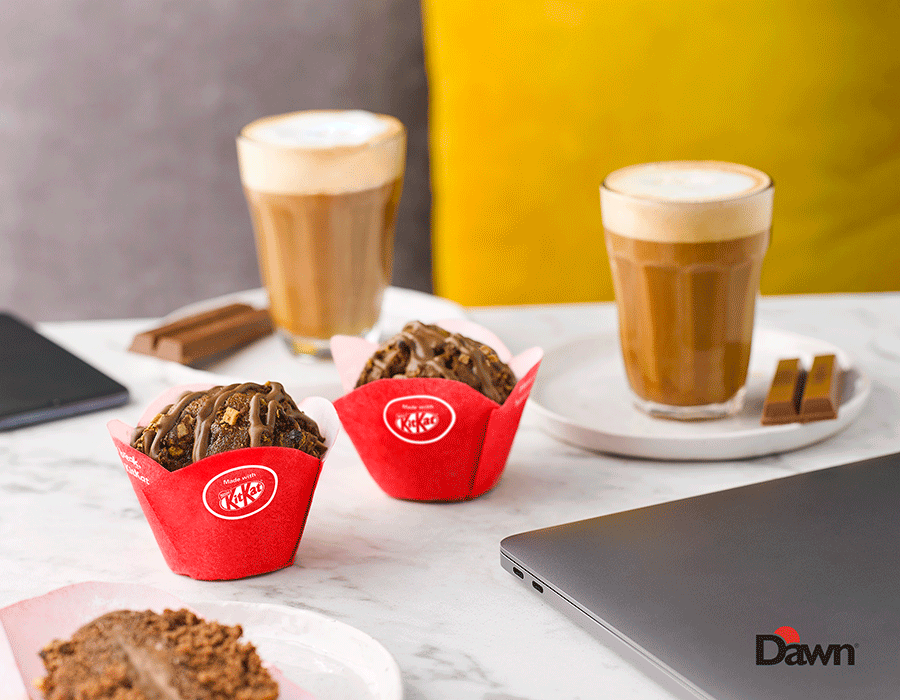
The first product launched will be a soft and delicious top-quality muffin with the great KITKAT® ingredients taste, filled with milk chocolate and richly covered with KITKAT® topping. To make them instantly recognizable to consumers, the muffins are wrapped in branded “Made with KITKAT®” cups and will be supported with in-store promotional materials.

The muffin made with KITKAT® is the result of Dawn Foods’ market leadership in American pastry and the strengths of Nestlé’s confectionary brands which gives the unique KITKAT® product taste experience. Dawn Foods and Nestle Professional® have agreed a long-term commitment to co-design new bakery products that carry the essence of the brand by combining state of the art bakery mixes with the best branded ingredients”, says Steven Verweij, President, Europe & AMEAP, Dawn Foods.

The co-branded products will be available for bakery channels, quick service restaurants and other locations across Europe, Middle East & North Africa regions.

HOW CAN ROBOTS IMPROVE YOUR SUPPLY CHAIN?

The UK food industry is heavily reliant on a wide workforce. With thousands of applications in complex and simple processes, robots can substantially improve supply chains by replacing labour intensive processes. Such integration will realise substantial production cost reductions and with rapidly developing technologies, the cost to utilise robotic systems is lower than ever. Whereas robotic systems may have seemed impractical and unaffordable, many systems can now achieve payback timescales within two years.

By reviewing your current production chain setup, companies such as Elevate Installations, are able to identify key areas where automation can be implemented, enabling productiveness and consistency improvements throughout. Building upon FANUC’s diverse catalogue of systems, ideal solutions can be investigated and implemented. The robotic systems available are capable of a wide range of functionalities and can be integrated alongside existing infrastructure or new systems at the customers discretion.

Six FANUC M-710iC/50H robotsFigure 2 – Six FANUC M-710iC/50H robots have been installed to automate removing boxed bottles from pallets to conveyors. Image source from FANUC America Corporation Youtube Channel.


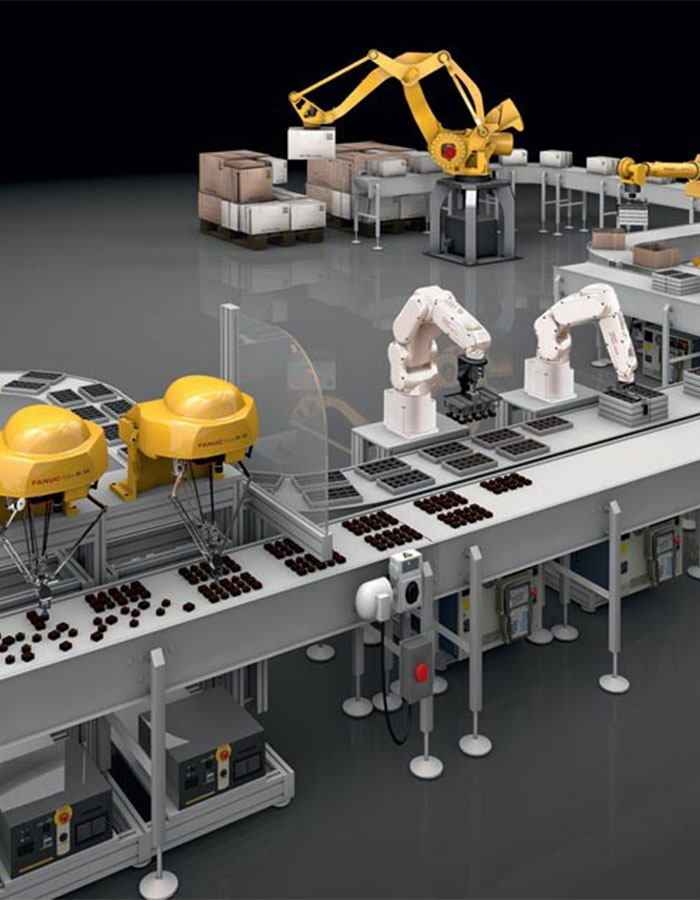
Ideal for food or beverage industry supply chains, FANUC supply multiple robots capable of handling or picking almost any product. Such systems may be used to transfer product between locations, for example from containers to a conveyor system for further processing.

Further down the production line, systems can be installed to automate product packing and pallet stacking, ready for transport. Intelligent vision systems can function alongside all solutions to track and recognise varied loads, adjusting positioning to transfer products and sort them most efficiently, achieving improved cycle times and compact loading.

FANUC picking and placing robots

Figure 3 – FANUC robots can be integrated to achieve picking and placing of many complex and irregular shaped products. Sourced from FANUC.EU

Through simple to change pre-set programs a system can rapidly transition from one application to another, often with minimal interaction required. Such systems then become multi-purpose and minimise changeover times, further reducing production costs.

With such diverse systems available, capable of wide-ranging load capacities, reach distances and functionalities, Elevate Installations can integrate robotics to assist alongside existing workforces or to fully automate processes and production lines with ease.

Member Benefits

Exclusive Partnership deals on key products and services:

  • BFFF energy deals and rates
  • Vypr member deals and introduction
  • Defib Plus deals
  • Company Shop – membership
  • Mentor – MHE training health check

Exclusive access to networking opportunities and events:

  • Meet the Buyer events (retail & foodservice)
  • Annual Business Conference with networking dinner
  • Specialist H&S and Technical Conferences
  • Special interest groups (packaging, frozen food temperatures)
  • Annual Lunch
  • Awards Night
Upcoming Events More Events
Sponsorship Packages

We offer a range of sponsorship opportunities to BFFF members across our events throughout the year, with flexible packages that can be tailored to suit your business objectives.

Contact Us
British Frozen Food Federation Members Logo
what our members say...
  • Wakefield Council

    “What an amazing piece of work and indicative of how BFFF respond to the concerns of their members and make an impact on the whole industry sector.”

    See Full Quote

  • Sysco

    “You guys really ‘Do The Right Thing’ for the good of the industry”

    See Full Quote

  • Darta

    “The BFFF awards night is becoming an “appointment not to miss” on our calendar and we again enjoyed it immensely together with lots of well-known people from our industry. The…

    See Full Quote

  • Kantar Worldpanel

    “The Business Conference was an excellent day that was very well organised and allowed so many likeminded individuals in the room to learn so much more around the Frozen industry….

    See Full Quote

  • Lakeside Food Group Ltd

    “This Not For EU labelling situation alarmed us and quickly became a major worry to our business. These are times when you really rely on some support and from previous…

    See Full Quote

  • Meadow Vale Foods Limited

    “We had a few questions with respect to the new EPR waste packaging legislative changes. I know some of my colleagues have been assisted by BFFF in the past so…

    See Full Quote

  • Newberry International Produce Ltd

    “I am writing to express my heartfelt gratitude for the outstanding event you organised. I have only worked in this sector for the past nineteen months coming from twenty-five years…

    See Full Quote

  • Place UK Ltd

    “The BFFF 2024 Conference was compelling and thought provoking, with a many relevant and interesting topics covered at great pace and some depth by excellent speakers – will certainly attend…

    See Full Quote

  • Roswel Spedition GMBH

    “Thank you and the team for rushing around so brilliantly before, during and after the conference. It was pleasure to be part of the conference.”

    See Full Quote

  • Seara

    “The event was great, in my opinion. Not only it was very well organised, but the venue and the catering were excellent too. Furthermore, the content of the presentations was…

    See Full Quote

Website Designed & Built by we are CODA