Become a member

City Centre Hotel Fined £24,000 for Health and Safety Failings

The owners of Bradford’s iconic Midland Hotel have been fined £24,000 after admitting a number of health and safety charges, including that they failed to act fast enough to deal with asbestos in the building.
However, Peel Hotels was told that it would have been fined “a six figure sum” had the company, and the hospitality industry in general, not been left in such a perilous financial situation due to the COVID-19 pandemic.

The national hotel chain appeared at Bradford and Keighley Magistrates Court charged with four offences relating to asbestos and health and safety failings. The issues had been reported to Bradford Council’s Environmental Health department by Gary Peacock, former manager of the hotel, shortly after he resigned from his role in 2018.
Along with the costs the company were ordered to pay to Bradford Council, Peel Hotels will have to pay a total of £30,000.

A representative from the company pleaded guilty to a charge of being an employer and failing to discharge general health, safety and welfare duty to employee, being aware of asbestos related material and failing to ensure the health and safety at work for the hotel’s employees. The second charge was similar but referred to the safety of people not in the employ of the hotel.

One charge related to a defect on a goods lift in the hotel, and another related to the hotel’s policy of working from height, and followed an accident that saw a worker fixing a light using a ladder falling and suffering an injury.

Giles Bridges, prosecuting on behalf of Bradford Council, told the court: “On May 16 2018 Environmental Health was contacted by Gary Peacock, the former manager of the Midland Hotel, who alleged there was an amount of Asbestos in various locations in the building and that the risk wasn’t being managed correctly.”
He said a lift engineer had pointed out the asbestos after doing some work in late 2017. Mr Peacock raised his concerns about the continued presence of asbestos in the hotel with the company, but felt the response was lacking.
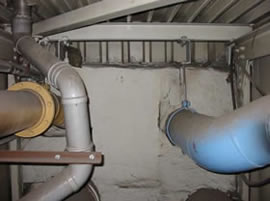
Areas with asbestos included a basement corridor, a lift shaft and a former kitchen area in the basement – areas used by staff but not customers.

Mr Bridges said: “What was being done to deal with it was not being done as quickly as it should have been.”
A report detailing the presence of asbestos was produced in November 2017, but by Spring 2018 Mr Peacock was concerned there had been no action taken. The alleged lack of action was one reason Mr Peacock had given for resigning in May 2018 – the court was told.

He informed Environmental Health, and two officers visited the hotel on 22 May. They saw the areas of asbestos and when they asked to see certain paperwork, such as health and safety assessments, staff were unable to produce them.
The court heard that the officers were “concerned” that the asbestos risk hadn’t been taken more seriously.
Robert Peel, owner of Peel Hotels, was interviewed in March 2019, and acknowledged the company should have taken steps to deal with the situation earlier. The company submitted a purchase order for works to remove the asbestos in April 2018 – but Mr Bridges pointed out that this only happened four months after the November 2017 report.
Charles Row, representing Peel Hotels, apologised to the court on behalf of the company for the failures to resolve the situation in a timely manner. He said: “The company has never before been subject to enforcement action, and prides itself on having a good working relationship with the local authorities in the areas it operates. We are extremely disappointed the company finds itself in this position.”

He said the action has motivated the company to make improvements to avoid similar situations in the future and pointed out that all the required work has been completed. He added: “The Midland Hotel is a good employer in Bradford, it is important for the city centre. It is important it continues to exist and thrive. It is a significant draw to travellers to the area.”

He pointed out that in the past two years the company had spent over £100,000 on asbestos removal, adding: “This shows the company takes this seriously. Even in difficult times the priority is given to spend money where needed.”
He argued that the company had taken action to deal with the asbestos, but that it was delayed due to negotiations with contractors and rising cost estimates provided. But he said the company had admitted there were “unacceptable delays” adding “it took months, and it shouldn’t have done.” He pointed out that there was no risk to the public, and very low risk to staff.
Overall the company was fined £24,000, and will have to pay Bradford Council £6,000 costs – less than the £9,260 the Council says it spent on the investigation.

The Telegraph and Argus
December 2020

Yoghurt and dessert manufacturer prosecuted after agency worker’s fingers amputated

A food company specialising in dairy products has been prosecuted after an agency worker suffered severe injuries when their fingers were caught in machinery.

Walsall Magistrates’ Court heard that following the incident on 12 July 2016, an agency worker had to have their middle finger amputated below the second knuckle, lost half their index finger and had their third finger amputated to the first knuckle. The agency employee was working as a box maker on a machine known as a tray erector, at the company’s Minsterley site in Shropshire, when the incident occurred.

The HSE found that the in-running nip on the tray erector was not properly guarded. The company had failed to guard dangerous parts of the machine to prevent access for more than seven years.

Müller UK and Ireland Group of Minsterley, Shrewsbury pleaded guilty to breaching Regulation 11(1) of the Provision of Use of Work Equipment Regulations 1998. The company was fined £66,000 and ordered to pay costs of £5,024.20.
Speaking after the hearing, HSE inspector Andrew Johnson said: “This preventable incident could have easily been avoided had the company properly assessed and applied effective control measures to minimise the risks from dangerous parts of the machinery.

“The dangers associated with in-running nips are well known, and a wealth of advice and guidance is freely available from HSE and other organisations.”

HSE
December 2020

USEFUL KEY CONTACTS DETAILS FOR GOVERNMENT

As you know the BFFF attend several Government led forums, flagging problems in real time, and trying to gain clarity in many areas on your behalf, such as the new import and export requirements as a result of EU exit and Covid. Rest assured, we will continue to do this to support members wherever possible.

To ensure issues are flagged without delay, Defra have issued us with a list of key contacts and have asked us to copy the relevant policy team in on any emailed queries. That list can be found here should you need to contact them directly yourselves.

All Defra’s EU Exit helpline numbers are also set out here, organised by subject matter: www.gov.uk/guidance/contact-defra

Sprinklers – The Facts and Myths

There is clear evidence that the installation of sprinklers can be effective in the rapid suppression of fires within all types of buildings reducing the risk of business disruption, injury and death. Sprinklers have been successfully used for the protection of property such as factories, department stores and shopping centres for well over 130 years and more recently with the increased use within domestic and residential properties including the mandatory inclusion in Wales for all new builds, there is clear evidence that the installation of sprinklers can be effective in the rapid suppression of fires, therefore considering this, suppression systems can be utilised either in existing buildings or at design stage of any new development to compensate for:

• Where compartment sizes will be exceeded.
• A compensatory feature where B5 Access and facilities for the fire service cannot be met.
• To allow a building construction in a previously denied location.
• Extended travel distances.
• Reduction in fire resistance of compartment.
• Increased unprotected areas relative to adjacent boundaries.
• Flexibility and innovation in design.
• More flexible use of the building

Sprinklers can increase the sustainability and life expectancy of buildings, by limiting fire development and significantly reducing the amount of smoke, CO2 & other pollutants. Because only the sprinkler head or heads immediately above the fire actuate, less water is used and there is a significant reduction in the amount of water run off carrying pollutants into the water system.

So let’s examine the myths:

Myth: When there is a fire all of the sprinklers go off together.
Fact: Sprinkler heads go off independently and only when directly affected by the heat of a fire.

Myth: Water from sprinklers causes more damage than the fire.
Fact: Because the sprinkler system attacks the fire immediately, it is much smaller than the fire the Fire Brigade meets when it arrives some 5 – 30 minutes later. Sprinklers typically use around sixty litres per minute of water each to control the fire which is between 4% and 1% of the water used by EACH Fire Brigade hose. So in the event of a fire the sprinklers will actually reduce water damage.

Myth: Sprinklers can go off accidentally.
Fact: Tests over the past 10 years show that the chances of a defective head are approximately 16 million to 1, which is slightly longer odds than you winning the lottery. This figure includes all types of defect and therefore the actual chance of an accidental discharge is considerably less.

Myth: Sprinklers are only designed to protect property, and are not effective for life safety.
Fact: Statistics show that there has never been any multiple loss of life in a fully sprinklered building. Property losses average 85% less with sprinklers compared to those without. Clearly sprinklers provide a high level of life safety. The combination of automatic sprinklers and early warning systems in all buildings and residences could reduce overall injuries, loss of life and property damage by at least 80%.

Myth: Sprinklers are too expensive to install.
Fact: in new buildings the costs of installing sprinklers, considered over the life span of the building, work out economically – roughly equivalent to carpeting the same building. It is also likely that insurers will offer premium discounts and policy excesses may be lower.

Myth: Sprinklers are to expensive to maintain.
Fact: Annual maintenance costs are reasonably low and would be a lot less than the cost of replacing machinery.

Myth: Sprinklers are ugly and affect the design of the building:
Fact: sprinklers actually allow design freedoms, they may allow larger rooms and a reduction in partitioning. Sprinklers can be recessed or flush mounted and unobtrusive.

Myth: Sprinklers only work on fires that can be put out with water.
Fact: Sprinklers can now be foam enhanced to control flammable liquid, chemical and petroleum fires.

INTERNATIONAL FROZEN FOOD TRADE ASSOCIATIONS

On the 22nd January 2021, I attended my second Zoom call with a group of International Frozen Food trade associations. We held our first call as a group in December and we planned this next call to follow up on ideas and suggestions from the initial call.

In total there are 7 trade bodies, including BFFF, across EU, UK and USA:

USA
Germany
Holland
France
Italy
Austria

We have agreed to co-operate across three common areas:

  1. Food Safety
  2. Sustainability
  3. Communications

Each country undertakes a range of activities to support the Frozen Food Industry and I certainly feel we can learn from how different Federations work in promoting the Industry.

In America (March) and Holland (May) both run Frozen Food Months, while in Germany they hold a Frozen Food Day – this year on the 6th March – perhaps the BFFF can arrange a similar focus in the UK during 2022?

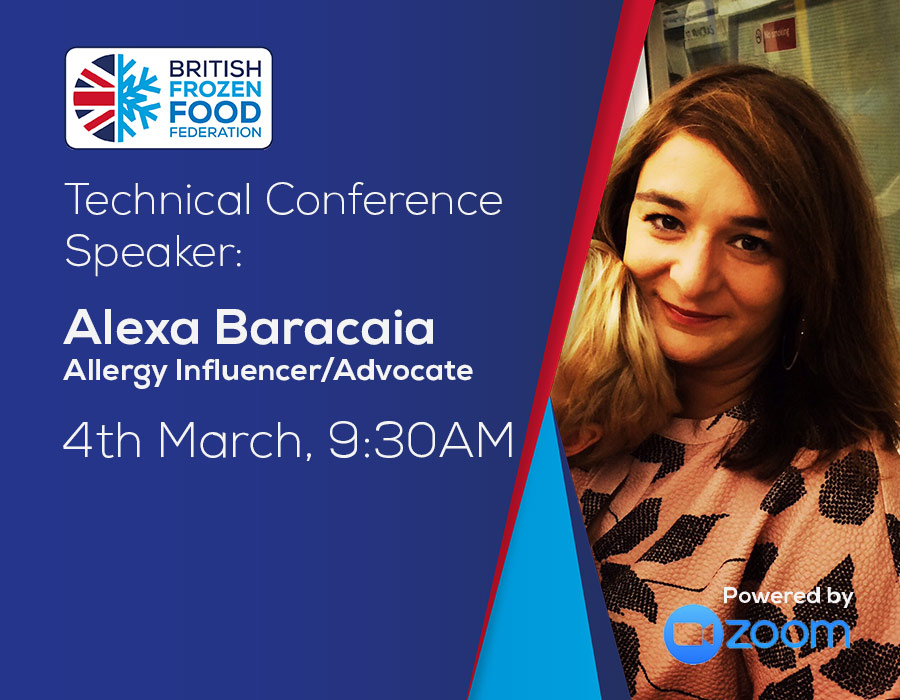
ALEXA BARACAIA – ALLERGY INFLUENCER/ADVOCATE

Alexa Baracaia is a journalist and social media consultant. Her son Sidney, now nine, was diagnosed with multiple severe food allergies at five months old. She initially took to Twitter to seek out others in the same boat, and has gone on to become a vocal allergy advocate, leading campaigns to counter blanket ‘may contain’ labelling, advising chains including Leon, founding the popular weekly Twitter forum #allergyhour and co-ordinating a 150-strong group response to Defra’s recent allergen labelling consultation. She believes clear and empathetic communication – from all sides – is at the heart of any good allergy policy.

We are pleased to have Alexa join us as our first speaker at this year’s Technical Conference on 4th March 2021.

Click Here to view the full programme.

Book your tickets now: https://bfff.co.uk/event/the-bfff-technical-conference/

To sponsor this conference contact Kate Miller katemiller@bfff.co.uk

Member Benefits

Exclusive Partnership deals on key products and services:

  • BFFF energy deals and rates
  • Vypr member deals and introduction
  • Defib Plus deals
  • Company Shop – membership
  • Mentor – MHE training health check

Exclusive access to networking opportunities and events:

  • Meet the Buyer events (retail & foodservice)
  • Annual Business Conference with networking dinner
  • Specialist H&S and Technical Conferences
  • Special interest groups (packaging, frozen food temperatures)
  • Annual Lunch
  • Awards Night
Upcoming Events More Events
Sponsorship Packages

We offer a range of sponsorship opportunities to BFFF members across our events throughout the year, with flexible packages that can be tailored to suit your business objectives.

Contact Us
British Frozen Food Federation Members Logo
what our members say...
  • Wakefield Council

    “What an amazing piece of work and indicative of how BFFF respond to the concerns of their members and make an impact on the whole industry sector.”

    See Full Quote

  • Sysco

    “You guys really ‘Do The Right Thing’ for the good of the industry”

    See Full Quote

  • Darta

    “The BFFF awards night is becoming an “appointment not to miss” on our calendar and we again enjoyed it immensely together with lots of well-known people from our industry. The…

    See Full Quote

  • Kantar Worldpanel

    “The Business Conference was an excellent day that was very well organised and allowed so many likeminded individuals in the room to learn so much more around the Frozen industry….

    See Full Quote

  • Lakeside Food Group Ltd

    “This Not For EU labelling situation alarmed us and quickly became a major worry to our business. These are times when you really rely on some support and from previous…

    See Full Quote

  • Meadow Vale Foods Limited

    “We had a few questions with respect to the new EPR waste packaging legislative changes. I know some of my colleagues have been assisted by BFFF in the past so…

    See Full Quote

  • Newberry International Produce Ltd

    “I am writing to express my heartfelt gratitude for the outstanding event you organised. I have only worked in this sector for the past nineteen months coming from twenty-five years…

    See Full Quote

  • Place UK Ltd

    “The BFFF 2024 Conference was compelling and thought provoking, with a many relevant and interesting topics covered at great pace and some depth by excellent speakers – will certainly attend…

    See Full Quote

  • Roswel Spedition GMBH

    “Thank you and the team for rushing around so brilliantly before, during and after the conference. It was pleasure to be part of the conference.”

    See Full Quote

  • Seara

    “The event was great, in my opinion. Not only it was very well organised, but the venue and the catering were excellent too. Furthermore, the content of the presentations was…

    See Full Quote

Website Designed & Built by we are CODA