Members may have seen that Defra have now provided an up date on the EPR consultation. As we advised the start date of EPR has now been pushed back.
The scheme will move back to 2024, EPR will also only pay costs associated with the recovery of household waste and street bins. The requirement to cover costs for business waste will now be reviewed by a task force. It appears the requirement to cover costs for littering has been dropped.
It has been decided that brand owners and importers of packaging will be responsible for the reporting and payment of fees.
Modulated fee payments are now delayed from 2024 to 2025. They have also decided not to reduce the de minimus threshold of £2m or 50 tonnes of packaging. However they have added a new reporting de minimus of £1m or 25 tonnes of packaging, members between these two bands will be required to report but no fees will be charged.
The scheme administrator is planned to be a public company, being mobilised by 2023 and fully operational by 2024.
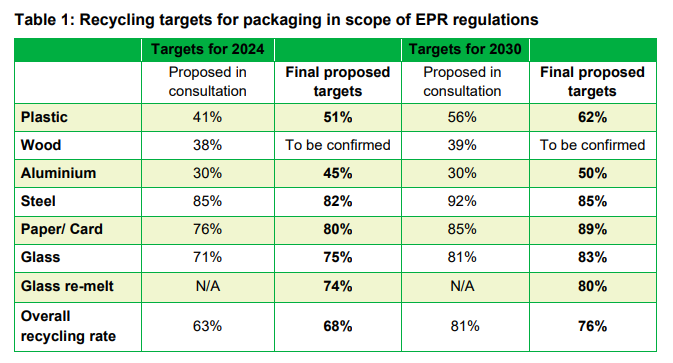
The up date also provides information on recycling targets from 2024 and 2030, there will also be further targets announced for the years in between. The full table is as follows
The following information will be required as part of the reporting
- All obligated producers will need to collate information under the following material
categories: Plastic, Glass, Steel, Aluminium, Wood, Paper/Card, Fibre-based
Composites, Other.
- Brand Owners, Importers, Distributors and Service Providers may also need to
collate packaging information such as:
- Packaging classed as ‘commonly placed in street bins’
- Additional material information – such as plastic polymer type, treated/untreated wood, or paper lamination
- Function – Primary, Shipment (packaging used to deliver goods direct to households), Secondary or Tertiary
- Waste stream – evidence regarding whether packaging is likely to end up in the household waste stream or not.
- Information about the product contained within the packaging – such as food/non-food, hazardous (as defined by EN643)/non-hazardous, silicone,
mastic etc.
- Packaging components – the components that make up the whole packaging item and the weight of each component
- Recycling disruptors – such as metal components, carbon black colouring, UV inks and varnishes etc.
- Recycling enablers – such as detectable inks that allow for enhanced sorting and reprocessing
- Format/packaging description – for example tub, tray, bag, box, jar, etc Colour of material
However it is clear that the reporting of different types of material will add a massive amount of extra complexity to this requirement.
We will provide further insight on this up once we have had a chance to read it further and consult with various experts in their fields. Any member wishing to read the entire update can find it by following this link
https://assets.publishing.service.gov.uk/government/uploads/system/uploads/attachment_data/file/1063589/epr-consultation-government-response.pdf


 + 44 (0) 1400 283090


 March 28th, 2022.


























 + 44 (0) 1400 283090